



Why this funding surge matters now
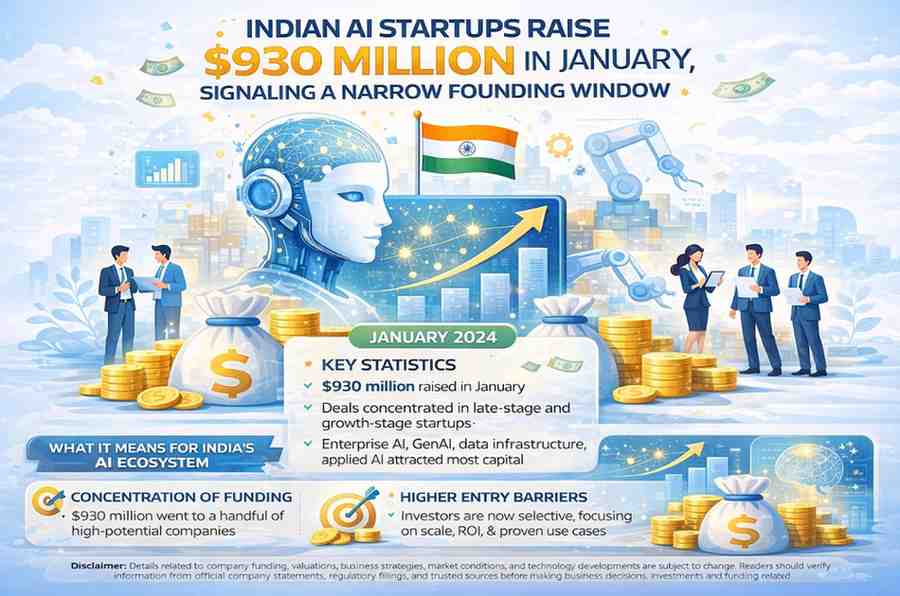
India’s artificial intelligence (AI) startup ecosystem has opened the year with a strong funding signal. Indian AI startups raised nearly $930 million in January, marking one of the most active months for AI-focused investments in recent times.
At first glance, the number suggests rising investor confidence in AI. But a closer look reveals a more complex reality. While capital is flowing into AI, funding is becoming more selective, and the window for new founders to enter the market is narrowing fast.


This trend has major implications for entrepreneurs, investors, and India’s position in the global AI race.
January Funding Snapshot: The Big Picture
Key numbers at a glance
- Total AI funding raised: $930 million
- Time period: January
- Primary focus: Enterprise AI, GenAI, data infrastructure, and applied AI
- Deal concentration: Skewed toward late-stage and scale-up companies
The funding volume makes AI one of the top-funded technology segments in India at the start of the year.
Strong headline number, limited participation
Despite the large total amount:
- A small number of startups accounted for most of the capital
- Early-stage and first-time founders saw fewer funding opportunities
- Investors focused on companies with clear revenue, clients, and IP
This has led to concerns about a shrinking entry point for new AI ventures.
Where the Money Is Going
Late-stage and growth-stage startups dominate
Most of the $930 million raised in January went to:
- Established AI startups with global clients
- Companies showing strong enterprise demand
- Firms working on applied AI rather than experimental products
These startups already have traction, predictable revenue, and proven use cases.
Enterprise AI and GenAI lead investor interest
Funding activity was strongest in areas such as:
- Enterprise AI platforms
- Generative AI tools for business workflows
- Data analytics and decision intelligence
- AI infrastructure and model deployment
Pure consumer AI apps attracted far less capital.
Why the Founding Window Is Narrowing
Higher expectations from investors
Investors now expect AI startups to show:
- Clear business use cases
- Paying customers, not pilots
- Responsible and scalable AI models
- Strong technical teams with domain depth
Ideas alone are no longer enough.
Rising cost of building AI companies
Launching an AI startup today requires:
- Expensive compute and cloud infrastructure
- Access to quality data
- Skilled AI engineers and researchers
- Compliance with data and AI governance norms
These costs create high barriers for new entrants.
Shift From Experimentation to Execution
AI funding is no longer exploratory
In earlier years, investors funded AI startups to test possibilities.
Today, the focus has shifted to:
- Deployment at scale
- Measurable impact on revenue or efficiency
- Integration with existing enterprise systems
Startups that cannot show near-term value are struggling to raise funds.
Proof over promise
Founders are expected to answer tough questions early:
- Who is paying for this AI?
- What problem does it solve today?
- Can it scale without heavy losses?
This change has compressed the timeline for success.
Impact on Early-Stage and First-Time Founders
Seed funding is harder to access
While capital exists, seed-stage AI startups face:
- Longer fundraising cycles
- Smaller cheque sizes
- More investor rejections
Many early-stage founders are being advised to bootstrap longer before approaching investors.
Team quality matters more than ever
Investors are backing:
- Founders with deep AI or domain experience
- Teams that have built AI systems before
- Startups with strong technical credibility
This makes it harder for non-technical founders to break in.
Why Investors Are Still Bullish on AI
AI budgets are growing globally
Despite caution in startup funding, enterprises continue to:
- Increase AI spending
- Shift budgets from pilots to production
- Look for AI-led productivity gains
This creates long-term demand for reliable AI vendors.
India’s talent advantage remains strong
India continues to offer:
- A large pool of AI and data talent
- Cost-efficient engineering teams
- Growing enterprise and global client base
These factors keep India attractive for AI investment.
Global Context: India Mirrors a Larger Trend
Funding concentration is a global pattern
The narrowing funding window is not unique to India.
Globally:
- AI funding is flowing to fewer, stronger companies
- Late-stage startups are absorbing more capital
- New founders face higher entry barriers
India’s AI ecosystem is following the same path.
Regulation and responsibility also play a role
Growing focus on:
- Data privacy
- Ethical AI
- Model transparency
has increased compliance costs, further raising the bar for new startups.
What This Means for Aspiring AI Founders
Timing is critical
Founders planning to enter AI now must:
- Choose niches carefully
- Build with real users in mind
- Avoid generic AI products
The market rewards focus, not breadth.
Deep tech, not surface-level AI
Startups working on:
- Core models
- Infrastructure
- Industry-specific AI solutions
stand a better chance than those building wrapper products.
Opportunities Still Exist, But They Are Selective
Underserved enterprise problems
AI opportunities remain in:
- Manufacturing optimisation
- Healthcare diagnostics
- Financial risk and compliance
- Supply chain intelligence
These areas demand patience and domain expertise.
Global-first approach is becoming essential
Many investors prefer startups that:
- Target global customers early
- Build scalable, export-ready products
- Are not limited to the Indian market
This raises both ambition and complexity.
What to Watch in the Coming Months
Will funding broaden or tighten further?
Key signals to track include:
- Number of seed-stage AI deals
- Investor appetite beyond top startups
- Entry of new AI-focused funds
If early-stage funding does not recover, the founding window may shrink further.
Policy and infrastructure support
Government and institutional support for:
- Compute access
- Research infrastructure
- AI skilling
could help lower barriers for new founders.
The Bigger Picture
AI in India is maturing fast
The $930 million raised in January shows that:
- AI is no longer a fringe category
- Serious capital is backing serious companies
- The ecosystem is moving from hype to execution
This is a sign of maturity, not decline.
But the cost of entry is rising
As AI becomes central to business and governance:
- Competition intensifies
- Expectations rise
- Only well-prepared founders succeed
The opportunity is large, but the margin for error is small.
Bottom Line
Indian AI startups raising $930 million in January reflects strong investor belief in the sector’s long-term potential. However, it also highlights a critical shift.
Funding is concentrating around fewer, more mature companies, and the window for new AI founders is narrowing rapidly.
For entrepreneurs, the message is clear: build deep, build focused, and build for real-world impact. In today’s AI market, ambition must be matched by execution from day one.
Financial Disclaimer
Startup investments, venture capital funding, and technology-sector valuations involve market risks and uncertainties. Funding figures and trends discussed are indicative and may vary over time. Readers should conduct independent research and consider consulting a qualified financial advisor or industry expert before making any investment or financial decisions.
Last Updated on Monday, February 9, 2026 11:51 am by Startup Newswire Team