


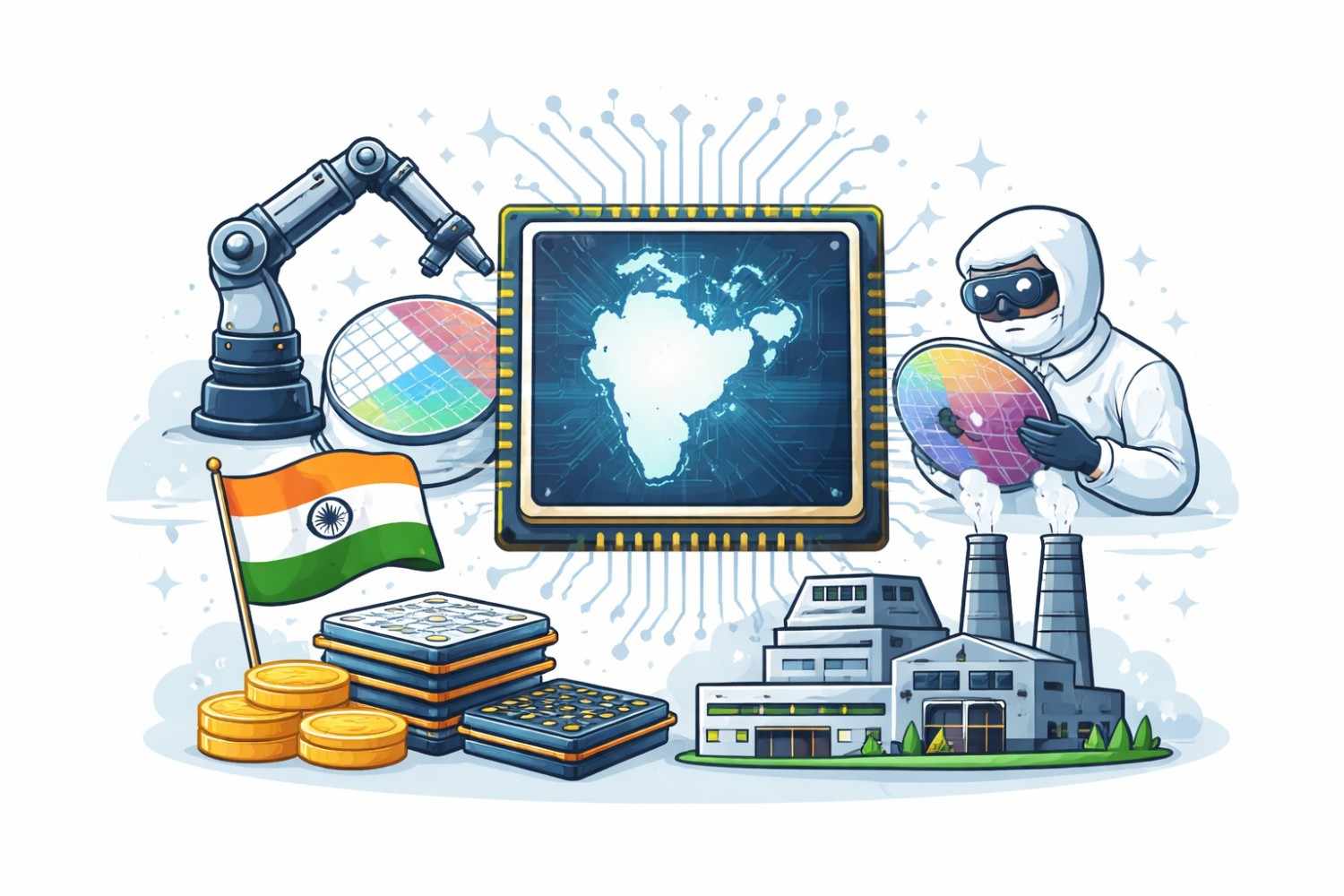
From Policy to Production: Charting India’s Chip Ecosystem Roadmap
New Delhi, India — India’s semiconductor ambitions are steadily moving from policy announcements to measurable production progress. Backed by government incentives and growing private investment, the country is working to build a complete chip ecosystem — from design and fabrication to assembly and testing — in an effort to reduce import dependence and strengthen its role in global supply chains.
A Policy Foundation: India Semiconductor Mission
India’s semiconductor push gained structure with the launch of the India Semiconductor Mission (ISM), supported by a financial outlay of ₹76,000 crore. The initiative was designed to attract investments in chip fabrication plants, display manufacturing, compound semiconductors, and semiconductor design.


The policy framework aims to position India as both a manufacturing hub and a design powerhouse. Officials have repeatedly stated that the long-term objective is to serve domestic demand while also producing chips for global markets.
India’s semiconductor market is projected to grow significantly by 2030, driven by rising demand from sectors such as consumer electronics, electric vehicles, telecom, defence, and data centres.
Expanding the Roadmap: ISM 2.0
Building on initial approvals and ecosystem groundwork, the government has introduced an expanded phase of the semiconductor mission. The next phase broadens the focus beyond fabrication units to include equipment manufacturers, material suppliers, and supporting infrastructure providers.
This ecosystem-based approach reflects global semiconductor industry realities, where chip production depends on a complex supply chain involving chemicals, precision tools, specialty gases, and advanced packaging systems.
Policy emphasis has also shifted toward strengthening research, intellectual property creation, and advanced manufacturing capabilities.
Early Production Milestones
India marked an important step forward in 2025 with the rollout of its first domestically produced semiconductor chips under approved projects. While initial production has largely focused on assembly, testing, marking, and packaging (ATMP), these milestones signal progress from approvals to operational activity.
Industry observers note that building a full-scale semiconductor fabrication facility is capital intensive and technologically complex. Early-stage output, therefore, represents foundational progress in a long-term strategy.
Several semiconductor projects have been approved across multiple states, creating clusters that combine manufacturing, logistics, and talent development.
Ambition for Advanced Nodes
India’s semiconductor roadmap includes long-term goals to manufacture advanced-node chips in the coming decade. Policymakers have indicated interest in moving toward smaller nanometer technologies that power artificial intelligence systems, high-performance computing, and advanced mobile devices.
Reaching advanced-node capability will require sustained investment, technology partnerships, and skilled workforce development. Industry experts caution that this is a multi-year journey that depends on stable policy support and global collaboration.
Focus on Design and Startups
In addition to manufacturing, India is strengthening its semiconductor design ecosystem. The Design Linked Incentive (DLI) scheme supports domestic firms engaged in chip design and product development.
India already has a strong presence in semiconductor design services, with many global firms operating research and development centres in cities such as Bengaluru, Hyderabad, and Noida. Policymakers aim to convert this design strength into product ownership and intellectual property creation.
Training programmes and academic partnerships have also been expanded to develop semiconductor engineers and technicians. Workforce readiness is seen as critical to sustaining production growth.
Strategic and Economic Importance
The push for semiconductor self-reliance gained urgency after global chip shortages disrupted industries worldwide. For India, reducing import dependence has both economic and strategic value.
Semiconductors are core components in smartphones, automobiles, defence equipment, and industrial systems. A domestic ecosystem can improve supply chain resilience while creating high-value jobs and attracting foreign investment.
Challenges Ahead
Despite progress, challenges remain. Semiconductor manufacturing requires stable power supply, advanced water management, skilled manpower, and long-term capital commitment. Global competition is also intense, with established hubs in Taiwan, South Korea, the United States, and China.
Analysts note that consistent execution, regulatory clarity, and timely project implementation will determine how quickly India can scale from pilot production to high-volume fabrication.
The Road Forward
India’s semiconductor journey reflects a clear shift from policy intent to early production outcomes. While advanced manufacturing goals remain long term, foundational steps — including infrastructure creation, investment approvals, and pilot chip production — indicate structured progress.
If current momentum continues, India could emerge as a significant player in specific segments of the semiconductor value chain over the next decade. The transition from policy frameworks to operational manufacturing will remain central to the country’s broader technology and industrial strategy.
Last Updated on Wednesday, February 11, 2026 6:58 pm by Startup Newswire Team