



Why This Policy Update Matters Now
India has taken a major step to strengthen its deep tech ecosystem.


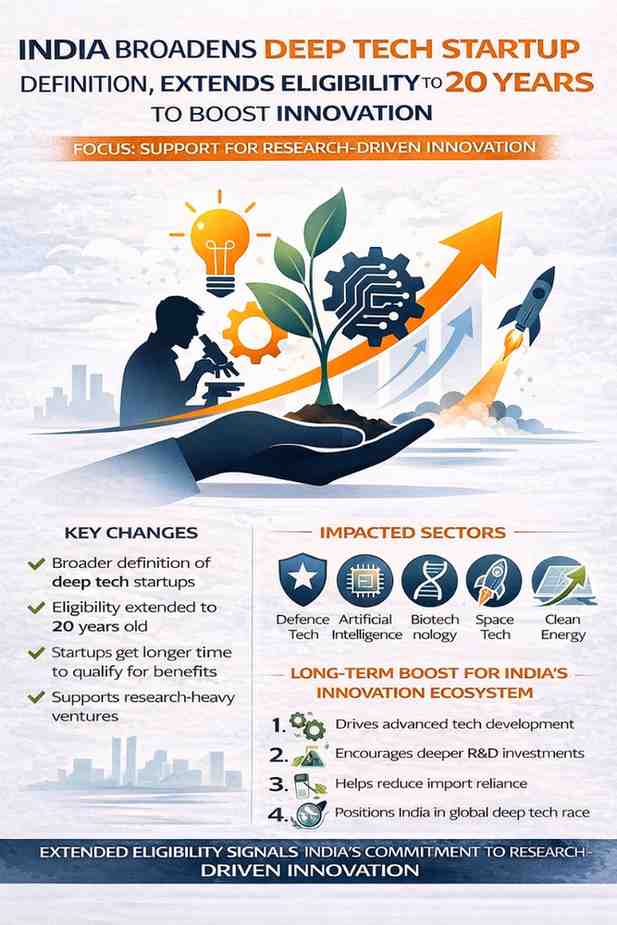
The government has broadened the definition of deep tech startups and extended eligibility benefits to companies that are up to 20 years old. This move is expected to support long-gestation research-driven ventures that require more time to commercialise advanced technologies.
For founders, investors and research institutions, the update signals stronger policy backing for innovation in sectors such as artificial intelligence, space technology, defence, biotechnology and semiconductors.
At a time when global competition in advanced technology is rising, India’s decision could reshape the country’s startup landscape.
What Has Changed in the Deep Tech Startup Definition
The updated framework expands the scope of what qualifies as a deep tech startup.
Deep tech companies typically work on:
- Artificial intelligence
- Robotics
- Quantum computing
- Biotechnology
- Aerospace and space tech
- Advanced materials
- Semiconductor design
Earlier, startup recognition and benefits were often limited to younger companies. By extending eligibility to 20 years, the government acknowledges that deep tech ventures often require longer research cycles.
This change recognises the difference between consumer tech startups and science-driven enterprises.
Extended Eligibility: Why 20 Years Is Significant
Most traditional startup policies focus on companies that are up to 10 years old.
Deep tech businesses, however, often face:
- Long research and development timelines
- Regulatory approvals
- Complex testing cycles
- High capital requirements
Extending eligibility to 20 years gives these firms more time to qualify for government support.
It allows companies to continue receiving recognition and benefits even during long product development phases.
What Qualifies as Deep Tech Under the Broader Definition
The broadened definition now focuses more on the nature of innovation rather than only company age.
A deep tech startup typically:
- Builds intellectual property based on scientific research
- Develops proprietary technology
- Invests heavily in R&D
- Solves complex technical problems
This distinguishes deep tech from app-based or service-based startups.
Sectors likely to benefit include:
- Defence manufacturing
- Climate technology
- Health technology
- Space research
- Clean energy systems
Why India Is Focusing on Deep Tech Now
Global competition in advanced technology has intensified.
Countries are investing heavily in:
- AI infrastructure
- Semiconductor manufacturing
- Space missions
- Defence innovation
India aims to reduce import dependence and build domestic capability in critical technologies.
Deep tech startups play a key role in this ambition.
They contribute to:
- National security
- Industrial growth
- Export potential
- Strategic independence
Support Under Startup India Framework
The policy changes are aligned with the broader objectives of Startup India, which was launched to promote entrepreneurship and innovation.
Startup India offers benefits such as:
- Tax exemptions
- Simplified compliance
- Intellectual property support
- Access to government tenders
By extending deep tech eligibility to 20 years, more mature research-driven companies can access these incentives.
Impact on Research-Based Startups
India has strong research institutions, including IITs, IISc and other science universities.
Many deep tech startups emerge from:
- Academic research
- Defence laboratories
- Space research collaborations
These companies often take years before commercial deployment.
Extended eligibility supports their transition from research labs to market-ready enterprises.
Encouraging Long-Term Innovation
Deep tech innovation requires patience and sustained investment.
Unlike consumer tech, which can scale quickly, deep tech often involves:
- Hardware prototyping
- Scientific validation
- Regulatory testing
- Infrastructure buildout
Extending eligibility to 20 years reflects an understanding that breakthrough technologies need time.
It sends a signal that India values long-term innovation over short-term gains.
Boost for Semiconductor and AI Ecosystem
India is currently investing in semiconductor manufacturing and AI infrastructure.
Deep tech startups in these sectors require:
- Advanced fabrication facilities
- High-performance computing
- Skilled technical workforce
Government support can help these companies reduce risk and attract private investment.
The extended eligibility period may improve investor confidence in research-heavy startups.
Defence and Space Tech Opportunities
India’s defence and space sectors are opening up to private participation.
Deep tech startups working on:
- Drone systems
- Satellite technology
- Advanced materials
- Autonomous systems
could benefit significantly from policy support.
Private participation in space and defence is increasing, and deep tech startups are positioned to play a larger role.
Climate and Clean Energy Innovation
Climate technology is another area where deep tech plays a key role.
Innovations in:
- Green hydrogen
- Carbon capture
- Battery storage
- Renewable energy systems
often require long development cycles.
The new policy framework supports startups tackling environmental challenges through science-driven solutions.
What This Means for Investors
Investors often hesitate to back deep tech startups due to:
- Long return timelines
- High capital intensity
- Regulatory uncertainty
Extended eligibility reduces some policy-related uncertainty.
It signals stable government backing, which can:
- Improve funding prospects
- Encourage institutional investment
- Attract global venture capital
Deep tech requires patient capital. Policy clarity helps create confidence.
Potential Challenges Ahead
While the policy update is positive, challenges remain.
Deep tech startups still face:
- Limited domestic R&D funding
- Infrastructure gaps
- Talent shortages in niche fields
- Global competition
Policy reform alone is not enough. Ecosystem development is equally important.
India must continue investing in research institutions, manufacturing capacity and skilled workforce training.
Alignment With India’s Long-Term Vision
India aims to become a global technology leader over the next two decades.
Deep tech development supports:
- Strategic autonomy
- Export competitiveness
- High-value job creation
Extending eligibility to 20 years aligns with this long-term vision.
It shifts the focus from rapid scaling to sustainable innovation.
What Founders Should Know
Deep tech founders should review:
- Updated eligibility criteria
- Tax exemption rules
- IP support mechanisms
- Government procurement opportunities
Recognition under Startup India can improve credibility when raising funds or entering partnerships.
Founders should also maintain clear documentation of R&D activities and intellectual property development.
Global Comparison
Countries like the United States, China and Israel provide strong support for deep tech.
India’s move narrows the policy gap and strengthens its position in global innovation rankings.
Support for longer development timelines is common in advanced economies.
By adapting its framework, India signals readiness to compete at a global level.
Broader Impact on India’s Startup Ecosystem
India is already one of the world’s largest startup ecosystems.
However, much of its growth has been in fintech, edtech and consumer apps.
The broadened deep tech definition could:
- Diversify the startup landscape
- Increase science-driven entrepreneurship
- Promote hardware innovation
- Encourage academia-industry collaboration
It may also inspire more students and researchers to build startups based on scientific research.
What Happens Next
The real impact of this policy will depend on:
- Implementation clarity
- Speed of approvals
- Access to funding channels
- Industry participation
Stakeholders will closely watch how effectively the updated definition translates into measurable growth.
Bottom Line
India’s decision to broaden the deep tech startup definition and extend eligibility to 20 years marks a significant policy shift.
It recognises that research-intensive innovation requires time, capital and sustained support.
For founders, investors and researchers, this move strengthens India’s commitment to building a science-driven innovation economy.
As global competition in advanced technologies intensifies, deep tech startups may become central to India’s next phase of economic growth.
The policy update is not just an administrative change. It is a strategic step toward long-term technological leadership.
Disclaimer: The information presented in this article is intended for general informational purposes only. While every effort is made to ensure accuracy, completeness, and timeliness, data such as prices, market figures, government notifications, weather updates, holiday announcements, and public advisories are subject to change and may vary based on location and official revisions. Readers are strongly encouraged to verify details from relevant official sources before making financial, investment, career, travel, or personal decisions. This publication does not provide financial, investment, legal, or professional advice and shall not be held liable for any losses, damages, or actions taken in reliance on the information provided.
Last Updated on Friday, February 13, 2026 11:41 am by Startup Newswire Team