
Startup India FoF 2.0 Approved With ₹10,000 Crore Corpus to Boost Deep Tech Innovation
Government Clears Second Fund of Funds to Strengthen India’s Startup Ecosystem, Focus on AI, Semiconductors and Emerging Technologies
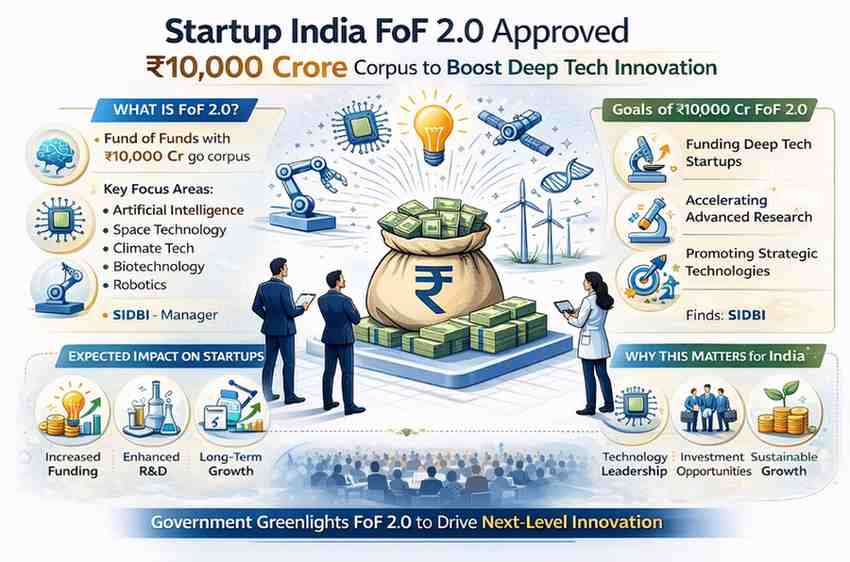
India’s startup ecosystem has received a major push with the approval of Startup India Fund of Funds 2.0 (FoF 2.0), backed by a corpus of ₹10,000 crore. The initiative is aimed at strengthening funding support for deep tech startups and accelerating innovation across critical technology sectors.
The decision is significant at a time when Indian startups are focusing more on advanced technologies such as artificial intelligence (AI), semiconductors, space tech, climate tech, and biotechnology. With global competition intensifying, the government’s move signals strong policy backing for long-term technology leadership.
The Fund of Funds 2.0 builds on the original Startup India Fund of Funds framework launched under the Startup Indiaprogramme.
What Is Startup India FoF 2.0?
Startup India FoF 2.0 is the second phase of the government-backed Fund of Funds for Startups (FFS). The new fund has been approved with a corpus of ₹10,000 crore.
Unlike direct funding schemes, the Fund of Funds model does not invest directly in startups. Instead, it invests in SEBI-registered Alternative Investment Funds (AIFs), which then deploy capital into startups.
The fund is managed by Small Industries Development Bank of India (SIDBI), which acts as the operating agency.
This structure allows professional fund managers to make investment decisions while leveraging government capital.
Focus on Deep Tech and Strategic Sectors
The key highlight of FoF 2.0 is its focus on deep tech.
Deep tech refers to startups working on advanced science and engineering innovations. These companies often require longer development cycles and higher capital investment.
Priority sectors under FoF 2.0 are expected to include:
- Artificial Intelligence
- Semiconductor design and manufacturing
- Robotics and automation
- Space technology
- Defence technology
- Climate technology
- Biotechnology
The government has identified these sectors as critical for India’s long-term economic and strategic growth.
Why Deep Tech Needs Special Support
Deep tech startups face unique challenges:
- High research and development costs
- Longer time to market
- Higher capital requirements
- Complex regulatory processes
Private investors sometimes hesitate to invest in such sectors due to longer return cycles.
The ₹10,000 crore corpus aims to address this funding gap.
By backing venture funds that invest in deep tech, the government hopes to de-risk innovation.
How FoF 2.0 Differs From the First Fund
The first Fund of Funds for Startups (FFS) was launched in 2016 with a corpus of ₹10,000 crore.
Over time, it committed funds to multiple AIFs, which in turn supported hundreds of startups across sectors.
FoF 2.0 builds on that foundation but shifts greater attention toward advanced technology sectors aligned with India’s current industrial priorities.
The second fund is also aligned with broader national initiatives such as:
- Make in India
- Digital India
- IndiaAI Mission
- Semiconductor Mission
Boost for Venture Capital Ecosystem
The Fund of Funds model strengthens the overall venture capital ecosystem.
When government-backed capital flows into AIFs:
- It increases fund size
- It attracts private co-investment
- It improves investor confidence
- It expands funding access for startups
For early-stage startups, this means improved chances of securing seed and growth capital.
Industry observers believe FoF 2.0 could help revive momentum in the funding ecosystem after a slowdown in recent years.
Startup India: A Decade of Growth
Since its launch in 2016, Startup India has played a major role in formalising and supporting the startup ecosystem.
According to official government data released in recent years:
- India has over 100,000 recognised startups
- Startups are present across most states and union territories
- The ecosystem has created significant employment
The introduction of FoF 2.0 marks the next phase of policy support.
Why This Matters for India’s Economy
Deep tech innovation has long-term economic implications.
Countries that lead in AI, semiconductors, and advanced manufacturing gain strategic advantages.
India aims to:
- Reduce technology import dependence
- Strengthen domestic manufacturing
- Increase high-value exports
- Build global technology brands
FoF 2.0 supports these broader national objectives.
Encouraging Long-Term Capital
Deep tech requires patient capital.
Unlike consumer apps, which may scale quickly, deep tech startups often take years to develop products.
Government-backed funding provides stability and encourages private investors to participate.
This blended funding model spreads risk and strengthens investor confidence.
Impact on Tier-2 and Tier-3 Cities
Startup India has expanded beyond major cities.
With improved digital infrastructure and state-level startup policies, innovation is now emerging from smaller cities.
FoF 2.0 could further strengthen this trend by enabling more venture funds to invest across regions.
Access to capital remains one of the biggest challenges outside metro hubs.
The new fund aims to improve capital distribution across geographies.
Policy Continuity and Investor Confidence
One of the key signals from FoF 2.0 is policy continuity.
Global investors closely watch government support for innovation.
By approving a second ₹10,000 crore fund, India signals long-term commitment to startup growth.
This could improve global perception of India as a stable innovation destination.
Challenges Ahead
While FoF 2.0 provides capital support, startups will still need to address:
- Talent shortages in advanced tech
- Infrastructure gaps
- Regulatory clarity
- Global competition
Capital alone cannot guarantee success.
However, funding support removes a major barrier.
What Happens Next
SIDBI will begin allocating commitments to eligible AIFs under FoF 2.0.
Once funds are deployed to venture capital firms, startups across priority sectors can begin accessing the capital.
The impact of FoF 2.0 will become clearer over the next few years as investments are announced and companies scale.
Conclusion
The approval of Startup India FoF 2.0 with a ₹10,000 crore corpus marks a significant step in strengthening India’s deep tech ecosystem.
With focus areas such as AI, semiconductors, robotics, and climate tech, the initiative aims to build long-term innovation capacity.
As India competes globally in advanced technology sectors, structured funding support becomes critical.
FoF 2.0 not only boosts startup financing but also reinforces India’s ambition to become a global technology powerhouse.
For founders, investors, and policymakers, this signals a new phase of deep tech-driven growth in the country’s startup journey.
Disclaimer: The information presented in this article is intended for general informational purposes only. While every effort is made to ensure accuracy, completeness, and timeliness, data such as prices, market figures, government notifications, weather updates, holiday announcements, and public advisories are subject to change and may vary based on location and official revisions. Readers are strongly encouraged to verify details from relevant official sources before making financial, investment, career, travel, or personal decisions. This publication does not provide financial, investment, legal, or professional advice and shall not be held liable for any losses, damages, or actions taken in reliance on the information provided.
Last Updated on Friday, February 20, 2026 12:24 pm by Startup Newswire Team
About The Author