
Explained: The Impact of New RBI Digital Lending Guidelines on Fintech Startups
India’s fast-growing digital lending sector is entering a new regulatory era as the Reserve Bank of India’s updated digital lending guidelines begin reshaping how fintech startups design products, partner with lenders, and interact with borrowers. The new framework, built around tighter compliance, borrower protection, and operational transparency, marks one of the most consequential regulatory interventions in the country’s fintech credit ecosystem. For startups that thrived on speed, scale, and flexible partnership structures, the changes represent both a stress test and a maturation moment.
Over the past decade, digital lending platforms transformed retail and small business credit in India. App-based onboarding, algorithmic credit scoring, and instant disbursements enabled fintech firms to reach customers overlooked by traditional banks. Young professionals, gig workers, and micro-entrepreneurs became a major borrower base, while non-banking finance companies and banks increasingly relied on fintech platforms for sourcing, underwriting support, and customer experience layers. The model produced rapid growth, but it also exposed regulatory blind spots around disclosures, data usage, recovery practices, and risk sharing.
Regulatory concern intensified as complaints mounted about opaque pricing, hidden charges, misuse of personal data, and aggressive recovery tactics by certain digital loan apps. The RBI responded by tightening norms and issuing consolidated digital lending directions that redefine accountability across the lending chain. The central bank’s approach is clear: innovation in credit delivery is welcome, but regulatory responsibility cannot be outsourced or diluted through technology intermediaries.
One of the most significant shifts under the new regime is the insistence that all loan disbursements and repayments must flow directly between the regulated lender and the borrower’s bank account. Earlier, several fintech structures allowed funds to pass through nodal or intermediary accounts managed by lending service providers or platform partners. Regulators concluded that such flows obscured accountability and increased customer risk. For fintech startups, this change forces a redesign of payment architecture, treasury handling, and reconciliation systems. Platforms that built value around wallet-based credit flows or layered disbursement mechanisms have had to reengineer their processes from the ground up.
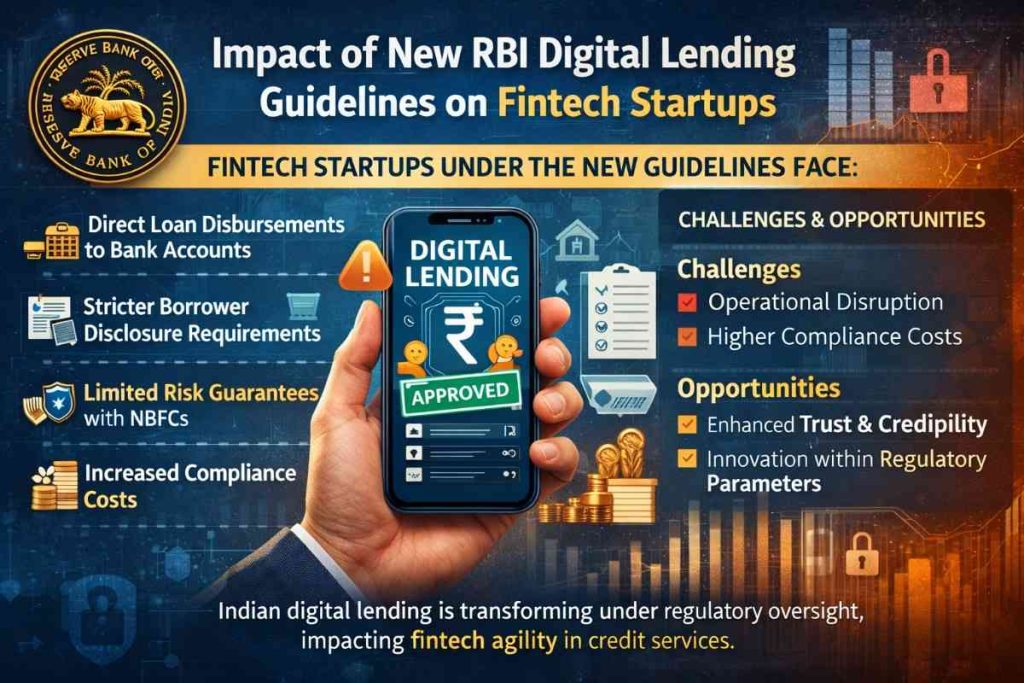
Transparency requirements have also been substantially strengthened. Borrowers must now receive standardized, clear disclosures covering the full cost of credit, including annualized interest rates, fees, penalties, and all charges associated with the loan. This information must be presented upfront and in a consistent format before loan acceptance. For fintech startups accustomed to compressed user journeys and simplified marketing messages, this creates a new balance challenge between frictionless onboarding and regulatory completeness. User interfaces, loan summaries, and consent flows are being rewritten to align with disclosure norms.
Another structural change affects how fintech startups share credit risk with regulated lenders. Many digital lending partnerships previously relied on contractual risk guarantees, often known as default loss guarantees, where the fintech partner would absorb a portion of credit losses in exchange for higher origination volumes or revenue share. The RBI has now capped and standardized such arrangements, placing limits on the extent of loss coverage and prescribing formal recognition and provisioning treatment. This directly impacts the economics of several fintech-NBFC partnerships. Startups that used guarantees as a lever to expand into thin-file or higher-risk segments must now recalibrate their credit models and partnership negotiations.
The new guidelines also draw a sharper line around the role of lending service providers, the category under which many fintech startups operate. While these firms may handle customer acquisition, technology platforms, data analytics, and servicing support, the regulated lender remains fully responsible for compliance, conduct, and grievance redressal. This removes any ambiguity about regulatory accountability but increases due-diligence expectations on both sides. Banks and NBFCs are tightening vendor audits, demanding stronger data controls, and inserting more detailed compliance clauses into partnership contracts. Smaller fintech startups are feeling the weight of these expanded oversight requirements.
Data governance has emerged as another core pillar of the revised framework. Explicit borrower consent, purpose limitation, and controlled data collection are now central expectations. Digital lending apps are required to limit access to only necessary device data and must provide clear consent trails. Startups that previously depended on expansive alternative data harvesting for credit scoring are being pushed to justify and narrow their data practices. This is prompting a shift toward more explainable underwriting models and greater investment in compliant data infrastructure.
Industry observers say the immediate effect of the tighter rules is a rise in compliance costs and a slowdown in product experimentation. Legal reviews, technology upgrades, audit processes, and reporting systems are absorbing management bandwidth and capital. Early-stage fintech lenders, especially those without deep funding or regulated affiliates, face a tougher operating climate. Some have paused loan originations while restructuring models, while others are seeking mergers or regulated licenses to stay competitive.
At the same time, larger and better-capitalized fintech firms view the regulatory tightening as a long-term positive. Clear rules reduce regulatory arbitrage, push out dubious operators, and build borrower trust in digital credit channels. Investors, too, are increasingly favoring startups that demonstrate compliance readiness and governance depth rather than pure growth velocity. Venture funding conversations in digital lending now routinely include regulatory architecture, audit readiness, and risk frameworks as core evaluation parameters.
Partnership dynamics between fintechs and traditional lenders are also evolving. Instead of loosely structured sourcing arrangements, newer alliances are becoming more integrated, with shared technology stacks, co-designed underwriting policies, and embedded compliance monitoring. Some fintech startups are pursuing their own NBFC licenses to gain direct regulatory standing, while others are doubling down on pure technology roles, positioning themselves as compliant infrastructure providers rather than quasi-lenders.
For borrowers, the regulatory shift is designed to produce a safer and more transparent experience. Clearer pricing, direct fund flows, stronger consent protocols, and defined grievance mechanisms are expected to reduce mis-selling and abuse. If effectively enforced, the framework could improve confidence in app-based borrowing and support sustainable credit expansion among underserved segments.
The broader consequence is that India’s digital lending story is moving from a phase of rapid disruption to one of regulated scale. The new RBI guidelines do not end fintech innovation in credit, but they change its operating grammar. Speed must now coexist with disclosure, growth with governance, and innovation with accountability. Startups that adapt quickly, invest in compliant technology, and build durable lender partnerships are likely to emerge stronger. Those that cannot align their models with the new regulatory expectations may find the runway shortening.
Add startupnewswire.in as preferred source on google – Click Here
Last Updated on Tuesday, February 3, 2026 1:59 pm by Startup Newswire Team
About The Author
