



Why this story matters now
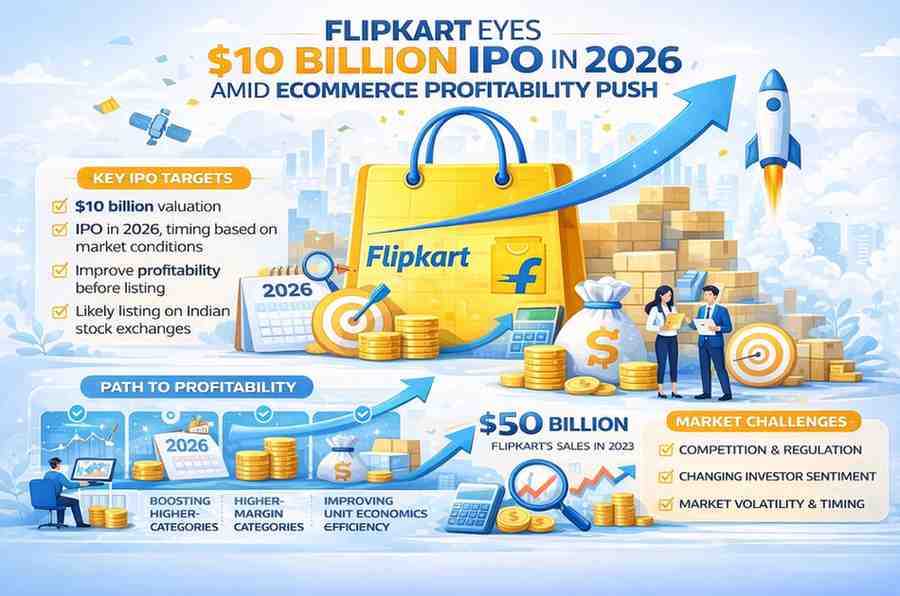
India’s ecommerce market is entering a decisive phase. After years of rapid growth funded by heavy cash burn, the focus has clearly shifted to profits, efficiency, and sustainable scale. Against this backdrop, Flipkart is preparing for what could be one of India’s biggest market events — a public listing targeted for 2026, with an expected valuation of around $10 billion.
The move signals growing confidence in Flipkart’s business model, even as competition intensifies and investors demand clearer paths to profitability.


Flipkart’s IPO Plan: What We Know So Far
Target timeline and valuation
Flipkart is understood to be working towards an IPO in 2026, subject to market conditions and regulatory approvals.
Key details emerging from industry tracking include:
- Proposed valuation: Around $10 billion
- IPO window: Calendar year 2026
- Likely listing venue: India, with domestic exchanges being actively evaluated
While the company has not officially announced the IPO, preparations are said to be underway internally.
Why 2026 is seen as the right window
The timing is deliberate.
By 2026, Flipkart aims to:
- Show consistent improvement in operating margins
- Reduce losses across core ecommerce operations
- Strengthen its balance sheet
- Present a clear growth-plus-profit story to public market investors
Market experts say a rushed listing could hurt valuation, especially in a cautious global environment.
Profitability Push Takes Centre Stage
From growth-at-all-costs to disciplined execution
Flipkart, like most ecommerce players, spent years prioritising scale over profits. That strategy helped build reach, logistics, and brand strength, but it also led to large losses.
Over the last few years, the company has:
- Cut back on deep discounting
- Optimised fulfilment and logistics costs
- Focused on higher-margin categories
- Tightened spending on marketing and customer acquisition
This shift mirrors a broader reset across India’s startup ecosystem.
Improving unit economics
Industry watchers point out that Flipkart’s unit economics have steadily improved, especially in:
- Fashion and lifestyle
- Private label products
- Seller services and advertising
These segments now play a bigger role in driving margins compared to low-margin electronics.
Walmart’s Role in the IPO Journey
Strategic backing from the parent company
Flipkart is majority-owned by Walmart, which acquired control of the Indian ecommerce firm in 2018.
Walmart’s backing has helped Flipkart:
- Access long-term capital
- Strengthen governance and compliance
- Adopt global best practices in supply chain and operations
The planned IPO is also expected to help Walmart unlock value from its India investment.
No immediate exit, but value creation
Analysts do not expect Walmart to fully exit post-listing.
Instead, the IPO is seen as:
- A partial monetisation opportunity
- A step towards long-term value creation
- A way to give Flipkart operational independence as a listed entity
How Flipkart Compares With Peers
Rivalry with Amazon and others
Flipkart continues to compete fiercely with Amazon in India.
The competitive landscape also includes:
- Reliance-backed platforms
- Quick commerce startups
- Niche vertical players
Unlike global peers, Indian ecommerce firms operate under tighter regulatory and pricing constraints, making profitability harder to achieve.
Public market lessons from recent listings
Recent IPOs of tech and consumer internet firms have shown that:
- Investors reward clear profit visibility
- High growth without margins attracts caution
- Governance and disclosure standards are under scrutiny
Flipkart’s 2026 plan appears aligned with these lessons.
Why a $10 Billion Valuation Matters
A reset from past expectations
At its peak, Flipkart was valued much higher in private markets.
A $10 billion IPO valuation reflects:
- More realistic pricing
- Adjusted expectations after global tech corrections
- Focus on sustainable earnings rather than speculative growth
Market participants see this as a healthier approach.
Signal for India’s startup ecosystem
Flipkart’s listing could:
- Revive IPO interest for large consumer internet firms
- Set benchmarks for valuation discipline
- Encourage late-stage startups to focus on profits before going public
For founders and investors alike, it could redefine what “IPO-ready” means in India.
Operational Changes Supporting the IPO Plan
Sharper focus on core ecommerce
In recent years, Flipkart has streamlined operations by:
- Reducing non-core experiments
- Improving seller quality and compliance
- Enhancing customer experience with faster deliveries
The aim is to present a simpler, stronger business story to investors.
Strengthening governance and compliance
As part of IPO preparation, companies typically:
- Improve board structures
- Strengthen financial reporting
- Align with public market disclosure norms
Flipkart is expected to accelerate these steps over the next 12–18 months.
Risks and Challenges Ahead
Market conditions remain uncertain
Global factors that could impact the IPO include:
- Interest rate trends
- Equity market volatility
- Investor appetite for tech listings
A weak market could delay timelines or affect valuation.
Competition and regulation
Flipkart must also navigate:
- Intense price competition
- Changing ecommerce regulations
- Pressure on margins from logistics and returns
Sustaining profitability while defending market share remains a delicate balance.
What Investors Will Watch Closely
Before committing capital, public market investors are likely to track:
- Path to net profit
- Cash flow trends
- Customer retention and order frequency
- Contribution margins by category
- Regulatory compliance and risk disclosures
Clear communication on these fronts will be crucial.
What This Means for Indian Consumers and Sellers
Limited short-term impact
For shoppers and sellers, the IPO plans are unlikely to cause immediate changes.
However, over time, a listed Flipkart may:
- Focus more on service quality than discounts
- Push for sustainable seller partnerships
- Invest selectively rather than aggressively
This could lead to a more stable ecommerce environment.
The Bigger Picture
A milestone moment for Indian ecommerce
If executed as planned, Flipkart’s 2026 IPO could be:
- One of the largest ecommerce listings in India
- A defining moment for the sector’s maturity
- Proof that large digital businesses can move towards profitability
It would also test investor confidence in India’s consumer internet story.
Bottom Line
Flipkart’s plan to target a $10 billion IPO in 2026 reflects a clear shift in strategy — from rapid expansion to financial discipline.
In a market where investors now demand profits alongside growth, the ecommerce giant is betting that two more years of focused execution will make it ready for public markets.
If successful, the listing could reshape expectations for India’s digital economy and set the tone for the next wave of tech IPOs.
Financial Disclaimer
Stock markets, IPOs, and investment-related products are subject to market risks and fluctuations. Valuations, timelines, and business projections mentioned are indicative in nature and may change. Readers should conduct their own research and consult a qualified financial advisor or market expert before making any investment decisions.
Last Updated on Monday, February 9, 2026 11:27 am by Startup Newswire Team