
Govt Doubles Deep Tech Startup Lifespan to 20 Years in Major Policy Overhaul
Why this move matters right now
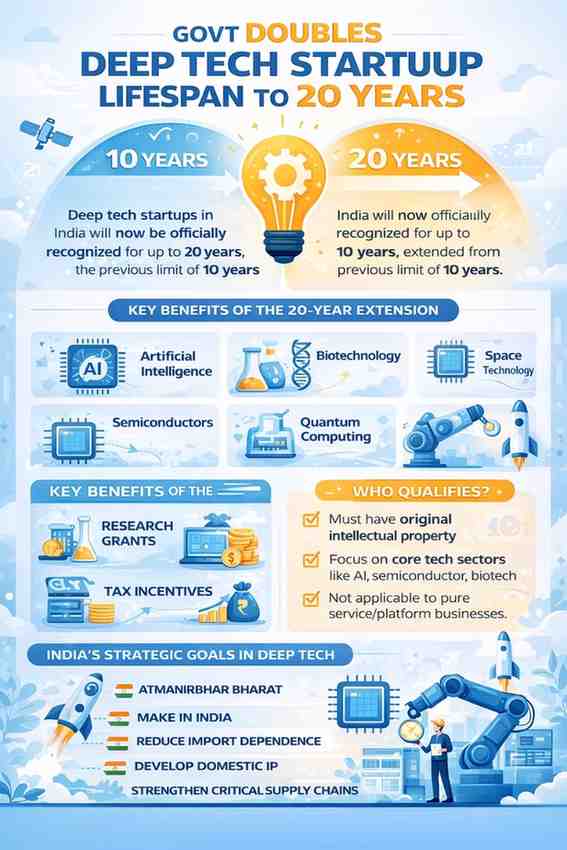
India has taken a major policy step to support long-term innovation. The central government has officially doubled the recognised lifespan of deep tech startups from 10 years to 20 years, giving founders more time, flexibility, and policy support to build complex technologies.
The decision is part of a broader deep tech policy overhaul, aimed at strengthening India’s position in areas like artificial intelligence, semiconductors, robotics, space technology, biotechnology, and advanced manufacturing.
For thousands of startups working on high-risk, high-cost research, this change could be a game-changer.
What Has Changed in the New Deep Tech Policy
Startup recognition period extended to 20 years
Under the revised framework:
- Deep tech startups will now be recognised for up to 20 years
- Earlier, recognition was capped at 10 years from incorporation
- The extended period applies to startups engaged in core scientific and engineering innovation
This recognition determines eligibility for government incentives, grants, tax benefits, procurement access, and research support.
Why deep tech startups need more time
Unlike consumer internet or app-based startups, deep tech companies:
- Spend years in research and testing
- Require large capital investment upfront
- Face long regulatory and certification cycles
- Often take 10–15 years before commercial returns
The government has acknowledged that a 10-year window was not realistic for such startups.
Which Startups Will Benefit From the New Rule
Focus on core technology sectors
The extended lifespan applies to startups working in areas such as:
- Artificial Intelligence (AI) and Machine Learning
- Semiconductors and chip design
- Quantum computing
- Biotechnology and life sciences
- Space and defence technologies
- Clean energy and climate tech
- Advanced materials and robotics
These sectors are considered strategic for India’s economic and national interests.
Not all startups automatically qualify
Officials have clarified that:
- The 20-year benefit is only for genuine deep tech startups
- Companies must show original intellectual property
- Pure service-based or platform businesses will not qualify
- Evaluation will be done through expert and government panels
This ensures the policy supports real innovation, not misuse.
Key Benefits for Startups Under the 20-Year Window
Longer access to government incentives
Recognised startups can continue to access:
- Research grants and seed funding
- Tax exemptions and incentives
- Easier compliance norms
- Public procurement opportunities
- Incubation and accelerator programmes
With a 20-year window, founders get double the time to build and scale.
Better support for patient capital
Deep tech investors often look for long-term policy stability.
This move helps:
- Reduce regulatory uncertainty
- Encourage patient capital and long-horizon funds
- Improve confidence among domestic and global investors
For venture capital and private equity firms, this signals that India is serious about deep tech.
Why the Government Took This Decision
Learning from global innovation models
Countries like the US, Germany, Israel, and South Korea offer long-term support for deep technology companies.
India’s earlier 10-year limit was seen as misaligned with global practices.
The revised policy brings India closer to international innovation standards.
Boosting India’s strategic self-reliance
The policy aligns with national goals such as:
- Atmanirbhar Bharat
- Make in India
- India Semiconductor Mission
- National AI Strategy
By supporting deep tech startups longer, the government aims to:
- Reduce import dependence
- Build domestic IP
- Strengthen critical supply chains
Impact on India’s Startup Ecosystem
Stronger survival rates for deep tech firms
Many deep tech startups shut down not due to poor ideas, but due to:
- Funding gaps
- Delayed commercialisation
- Loss of policy support after 10 years
The extended recognition period can significantly improve survival and success rates.
Encouragement for academic and research spin-offs
Universities and research institutions often take years to convert lab research into products.
With a 20-year window:
- Professors and researchers may feel more confident starting companies
- More IP-driven spin-offs are expected
- Collaboration between academia and industry could increase
What Changes for Founders and Entrepreneurs
More time to build, test, and scale
Founders now have:
- Greater freedom to focus on core research
- Less pressure to rush commercialisation
- Better alignment with long product cycles
This is especially critical for health tech, space tech, and hardware startups.
Improved planning and fundraising
With longer recognition:
- Business plans can be more realistic
- Founders can approach long-term investors
- Government-backed funds may increase ticket sizes
This reduces the risk of startups being forced into premature exits or pivots.
Concerns and Challenges Ahead
Clear definition of “deep tech” is crucial
Industry experts caution that:
- If definitions are vague, misuse is possible
- Strict and transparent criteria are essential
- Regular reviews should ensure only eligible startups benefit
The success of the policy depends on fair and expert-driven implementation.
Execution matters more than announcements
While the policy shift has been welcomed, startups will watch closely for:
- Speed of approvals
- Ease of compliance
- Coordination between ministries and agencies
Past experiences show that policy intent must be matched by ground-level execution.
How This Policy Fits Into India’s Long-Term Vision
Building a knowledge-driven economy
India aims to move from:
- Services-led growth
to - Innovation-led growth
Deep tech startups play a central role in this shift.
The 20-year recognition policy supports:
- Long-term R&D
- Creation of high-skilled jobs
- Global competitiveness in advanced technologies
Positioning India as a global deep tech hub
With this move, India sends a clear signal:
- Deep tech founders are welcome
- Long-term innovation will be supported
- Policy stability is improving
This could attract global founders, researchers, and investors to build in India.
What Happens Next
The government is expected to:
- Release detailed implementation guidelines
- Define eligibility and evaluation mechanisms
- Align tax, funding, and procurement rules with the new framework
Startup founders are advised to review their recognition status and sector eligibility once official notifications are issued.
Bottom Line
The decision to extend the deep tech startup lifespan to 20 years marks one of the most important policy shifts for India’s innovation ecosystem in recent years.
By recognising the realities of long-term research and development, the government has taken a pragmatic and future-focused step.
If implemented well, this policy could help India produce globally competitive deep tech companies, strengthen strategic sectors, and move closer to becoming a technology powerhouse in the coming decades.
Last Updated on Monday, February 9, 2026 11:21 am by Startup Newswire Team
About The Author