Indian Startups Raise $3.31 Billion in Q1 2026, Funding Drops 36% Year-on-Year: Tracxn Report
Introduction: Startup Funding Slowdown Continues in Early 2026
India’s startup ecosystem saw a significant drop in funding during the first quarter of 2026, reflecting a cautious investment environment for venture capital.
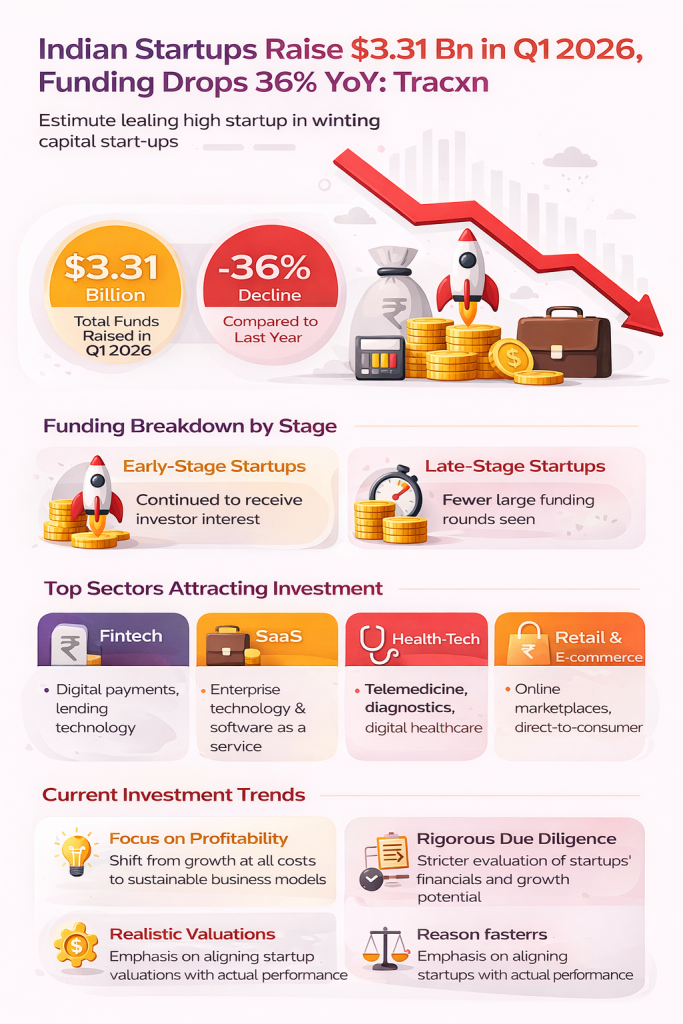
According to a report released by Tracxn, Indian startups raised $3.31 billion in Q1 2026, marking a 36% decline compared with the same period last year.
The data highlights a continued funding slowdown that began after the global venture capital boom of 2021 and early 2022. While India remains one of the world’s largest startup ecosystems, investors are now focusing more on profitability, sustainable growth, and disciplined spending.
For founders, investors, and policy makers, the latest figures offer a clear picture of how the Indian startup market is evolving in 2026.
Startup Funding in Q1 2026: Key Numbers
The report by Tracxn shows that startup investments in India remained active but lower than previous years.
Key highlights from the Q1 2026 funding data include:
- Total funding raised: $3.31 billion
- Year-on-year change: Down 36%
- Funding activity spread across multiple sectors including fintech, enterprise technology, retail, and health technology
- Venture capital firms remained active but selective in investment decisions
Although funding declined compared with the previous year, the amount raised still reflects strong investor interest in India’s innovation ecosystem.
India continues to rank among the top startup ecosystems globally, supported by a large digital user base and growing technology adoption.
Why Startup Funding Has Slowed
The drop in startup funding is not unique to India. Venture capital investments have slowed across global markets over the past two years.
Several factors are influencing investor behaviour.
Global Economic Uncertainty
Rising interest rates in major economies have changed how investors allocate capital. Higher borrowing costs often reduce venture capital activity.
Global investors have become more cautious and are focusing on lower-risk investments and companies with strong financial fundamentals.
Shift Toward Profitability
During the startup funding boom, many companies focused on rapid growth even if they were not profitable.
Today, investors are prioritising startups that show:
- Clear revenue models
- Sustainable growth
- Strong unit economics
This shift has slowed the pace of funding but may help create more stable businesses in the long term.
Valuation Corrections
Startup valuations increased sharply during the venture capital boom. Many investors now believe valuations need to align more closely with real business performance.
As a result, companies seeking funding are facing stricter due diligence and more realistic valuation expectations.
Which Sectors Continue to Attract Investment
Despite the overall slowdown, several sectors within the Indian startup ecosystem continue to attract investor attention.
Fintech
Financial technology startups remain among the most active segments in India’s startup ecosystem.
Companies working on:
- digital payments
- lending technology
- financial infrastructure
continue to draw interest from venture capital firms.
India’s expanding digital payments ecosystem has created opportunities for startups building solutions for consumers and businesses.
Enterprise Technology and SaaS
Software startups that build products for businesses, often called Software-as-a-Service (SaaS) companies, remain attractive to investors.
These companies typically generate predictable revenue through subscription models and serve global markets.
Indian SaaS startups have gained strong recognition internationally in recent years.
Health Technology
Health-tech startups that focus on digital healthcare platforms, diagnostics, and telemedicine services are also seeing continued investor attention.
Demand for technology-driven healthcare solutions has increased following the pandemic and the expansion of digital health services.
Major Startup Hubs in India
India’s startup funding activity continues to be concentrated in a few major technology hubs.
Cities such as Bengaluru, Mumbai, and Delhi NCR remain key centres for venture capital investment.
These cities offer:
- strong technology talent pools
- access to venture capital firms
- established startup ecosystems
- global technology company presence
Among them, Bengaluru continues to be widely recognised as India’s leading startup hub.
The city hosts hundreds of technology companies, incubators, and venture capital firms that support new startups.
Early-Stage vs Late-Stage Investments
Another trend observed in recent funding data is a shift in the type of investments being made.
Early-stage startups are still able to raise funding, particularly if they show strong innovation or market potential.
However, late-stage funding rounds have become less frequent, as investors take a more cautious approach before committing large amounts of capital.
This shift means startups may need to demonstrate clear product-market fit and revenue traction before raising large funding rounds.
Impact on Startup Founders
For startup founders, the current funding environment requires a different approach compared with the earlier venture capital boom.
Many founders are now focusing on:
- improving operational efficiency
- reducing unnecessary spending
- extending cash runway
- building profitable business models
Investors increasingly expect startups to show a clear path toward profitability rather than relying solely on rapid growth.
While this creates challenges, it also encourages startups to build stronger and more sustainable businesses.
India’s Startup Ecosystem Still Shows Long-Term Strength
Despite the decline in quarterly funding, India remains one of the most important startup markets globally.
Several factors continue to support long-term growth.
Large Digital Economy
India has one of the world’s largest internet user bases. This creates a massive market for digital services, fintech platforms, and e-commerce companies.
Growing Investor Network
Domestic venture capital firms, global investors, and corporate venture arms continue to invest in Indian startups.
Even during slower funding cycles, investors remain interested in innovative companies with strong growth potential.
Government Support
Government initiatives supporting startups, digital infrastructure, and entrepreneurship have also contributed to the ecosystem’s expansion.
Programs encouraging innovation and technology development continue to play an important role in building new companies.
What Investors Are Looking for in 2026
The venture capital landscape in 2026 is expected to remain disciplined.
Investors are focusing on startups that demonstrate:
- clear business models
- efficient use of capital
- strong leadership teams
- scalable technology solutions
Startups that meet these criteria are more likely to secure funding even in a cautious investment environment.
This shift may also lead to higher quality startups entering the market.
Outlook for Startup Funding in 2026
While funding in Q1 2026 declined compared with the previous year, analysts believe the ecosystem is moving toward a more balanced and sustainable growth phase.
Instead of rapid funding growth, the focus is shifting toward:
- sustainable scaling
- responsible capital deployment
- stronger governance
These changes may help reduce the volatility that often affects startup ecosystems during investment cycles.
India’s long-term technology growth, combined with its large market and entrepreneurial talent, continues to attract global investor attention.
Conclusion: Funding Slowdown Signals Market Reset
The latest data from Tracxn shows that Indian startups raised $3.31 billion in Q1 2026, representing a 36% year-on-year decline in funding.
While the drop reflects a cautious investment environment, it also signals a broader shift in the global startup landscape.
Investors are moving away from aggressive growth strategies and are prioritising sustainable business models and financial discipline.
For India’s startup ecosystem, the transition could mark an important reset one that strengthens companies and prepares them for long-term growth in the years ahead.
Disclaimer: The information presented in this article is intended for general informational purposes only. While every effort is made to ensure accuracy, completeness, and timeliness, data such as prices, market figures, government notifications, weather updates, holiday announcements, and public advisories are subject to change and may vary based on location and official revisions. Readers are strongly encouraged to verify details from relevant official sources before making financial, investment, career, travel, or personal decisions. This publication does not provide financial, investment, legal, or professional advice and shall not be held liable for any losses, damages, or actions taken in reliance on the information provided.
Last Updated on Monday, March 16, 2026 12:14 pm by Startup Newswire Team
About The Author
