How AI Agents Could Reshape India’s Startup Workforce Over the Next Five Years

Artificial intelligence has already automated parts of software development, customer support, marketing, and operations. But the next phase of AI adoption is fundamentally different.
Instead of isolated tools helping employees complete tasks faster, startups are beginning to experiment with AI “agents” — systems capable of autonomously executing multi-step workflows with minimal human supervision.
That distinction matters.
An AI chatbot can answer a question.
An AI agent can complete an entire operational process.
For India’s startup ecosystem, where lean teams, aggressive scaling targets, and cost efficiency are deeply embedded into company culture, AI agents could become one of the most disruptive forces since cloud computing.
The consequences may not look like sudden mass unemployment. More likely, entire startup job functions could gradually shrink, merge, or disappear as autonomous systems handle repetitive knowledge work that previously required teams of people.
Industry experts increasingly believe the transformation will be structural rather than incremental.
And India — with its massive IT workforce, expanding SaaS ecosystem, and rapidly growing AI startup landscape — may become one of the most important testing grounds for this shift.
What Exactly Are AI Agents?
The term “AI agent” is often used loosely, but in practice it refers to AI systems that can independently perform goal-oriented tasks across multiple applications, datasets, and workflows.
Unlike traditional automation software, AI agents can:
- interpret natural language instructions
- reason through workflows
- access tools and databases
- generate outputs dynamically
- adapt to changing contexts
- coordinate across systems
In startup environments, this means AI systems can increasingly handle work that once required junior analysts, support executives, coordinators, recruiters, or sales development representatives.
For example:
- A customer support AI agent can resolve tickets, escalate edge cases, update CRM systems, and draft follow-up responses.
- A finance operations agent can process invoices, reconcile transactions, and flag anomalies.
- A recruiting agent can screen resumes, schedule interviews, and communicate with candidates.
- A marketing operations agent can generate campaign variants, monitor analytics, optimize ads, and prepare reports.
The technology is still evolving, and reliability remains uneven. But the direction of travel is becoming increasingly clear.
India’s AI Momentum Is Accelerating
India is rapidly emerging as a major AI development and deployment market.
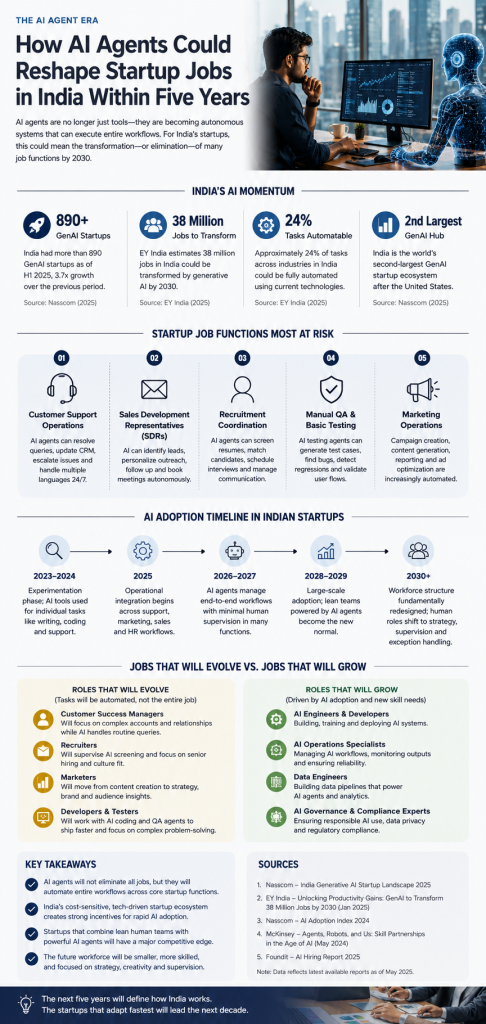
According to Nasscom, India’s generative AI startup ecosystem grew 3.7 times to more than 890 startups by the first half of 2025, making the country the world’s second-largest GenAI startup hub.
The same report noted that enterprise AI use cases are shifting from experimentation toward deployment, with startups increasingly building agentic systems and vertical AI applications.
India’s AI adoption is also being pushed by broader structural factors:
- lower operational margins for startups
- pressure to scale with smaller teams
- global investor demands for profitability
- rising software tooling maturity
- increasing availability of open-source AI models
Meanwhile, EY India estimated in 2025 that generative AI could transform 38 million jobs in India by 2030, with 24% of tasks across industries potentially capable of full automation.
Importantly, “transform” does not necessarily mean eliminate. In many cases, jobs may evolve rather than disappear entirely.
But some startup functions appear significantly more exposed than others.
Which Startup Job Functions Are Most Vulnerable?
1. Customer Support Operations
Customer support is among the clearest examples of AI agent disruption.
Many Indian startups — particularly in SaaS, fintech, edtech, and ecommerce — built large support teams to manage onboarding, troubleshooting, refunds, and ticket handling.
AI agents are increasingly capable of:
- handling multilingual conversations
- resolving repetitive queries
- understanding account history
- escalating only complex cases
- operating 24/7 at scale
India’s linguistic diversity was once considered a barrier to automation. But advances in multilingual large language models are reducing that advantage quickly.
Human support teams are unlikely to disappear entirely. High-empathy escalation handling and enterprise relationship management will still matter. But large first-level support teams may shrink significantly.
2. Sales Development Representatives (SDRs)
Early-stage startups have historically relied on SDR teams for lead qualification, outbound outreach, CRM updates, and meeting scheduling.
AI agents are beginning to automate large portions of that workflow.
Modern AI sales systems can:
- identify leads
- enrich contact databases
- personalize outreach emails
- follow up automatically
- score intent signals
- book meetings
The biggest change may occur in SaaS startups where outbound prospecting has already become highly data-driven.
This could reduce the need for large junior sales teams while increasing demand for higher-level account executives focused on relationship-building and enterprise negotiations.
3. Recruitment Coordination
India’s startup ecosystem scaled aggressively during the funding boom between 2020 and 2022, leading to major recruitment operations growth.
Now, hiring volumes are slowing in several sectors while AI hiring tools are improving rapidly.
Recruitment AI agents can already:
- parse resumes
- match candidates
- coordinate interviews
- draft job descriptions
- communicate with applicants
- generate evaluation summaries
Human recruiters will still remain important for senior hiring, culture evaluation, and negotiation. But coordination-heavy recruiting workflows may require far fewer people.
4. Manual QA and Basic Software Testing
Software testing is another area facing rapid automation pressure.
AI coding assistants and testing agents can increasingly:
- generate test cases
- detect regressions
- identify UI issues
- simulate user interactions
- monitor deployment quality
India’s IT services industry historically created enormous employment pipelines around repetitive testing work. AI threatens some of those foundational entry-level workflows first.
Even large IT firms are openly acknowledging the shift.
At a Nasscom event in 2026, Tata Consultancy Services CEO K Krithivasan said the company viewed AI primarily as an efficiency enabler rather than a direct employment threat, while encouraging internal AI adoption aggressively.
That framing reflects a broader industry reality: companies may not eliminate jobs overnight, but they could hire fewer people for the same output.
5. Marketing Operations and Content Production
Generative AI has already disrupted content workflows.
What changes with AI agents is workflow continuity.
Instead of assisting with isolated tasks, AI systems can increasingly manage:
- SEO monitoring
- ad optimization
- campaign reporting
- social content scheduling
- performance analysis
- email personalization
This is especially relevant for startups operating with lean growth teams.
Junior content and operations roles may become harder to justify unless employees develop higher-order skills around strategy, distribution, brand positioning, and audience insight.
Why India Could Experience This Faster Than Other Markets
Several structural characteristics make India uniquely exposed to AI-agent-driven workforce redesign.
A Large Services Economy
India’s tech ecosystem grew around scalable service delivery.
Many startup roles involve:
- repetitive digital workflows
- documentation
- support handling
- operational coordination
- structured communication
These are precisely the environments where AI agents perform best.
Strong AI Talent Availability
India has become one of the world’s largest AI talent pools.
According to Nasscom, India’s AI skills penetration significantly exceeds the global average.
That means Indian startups are not just consuming AI tools — they are actively building them.
Investor Pressure for Efficiency
After the post-2022 funding slowdown, investors began prioritizing profitability over hypergrowth.
AI agents align perfectly with that pressure.
Founders increasingly ask:
- Can the same work be done with half the headcount?
- Can support scale without proportional hiring?
- Can operational layers be reduced?
In many startups, AI adoption is becoming less about experimentation and more about survival economics.
But Elimination Is Not the Same as Replacement
The most important nuance in the AI debate is often lost in extremes.
Most roles will not disappear completely.
Instead, workflows inside those roles will change dramatically.
Historically, technology shifts eliminate specific tasks before eliminating entire professions.
For example:
- spreadsheets reduced manual accounting work
- cloud software reduced infrastructure maintenance
- ecommerce reduced some retail staffing needs
AI agents may follow a similar pattern.
A recruiter may supervise AI-driven hiring pipelines instead of manually coordinating every interview.
A marketer may direct autonomous campaign systems rather than create every asset manually.
A support manager may oversee AI escalations instead of answering tickets personally.
Research increasingly supports this augmentation model.
A recent McKinsey report argued that AI-driven workplaces are likely to become partnerships between humans, agents, and automated systems rather than fully human-free environments.
The bigger disruption may therefore be organizational structure.
Startups May Become Smaller by Default
One of the clearest long-term implications is that startups may require fewer employees to reach meaningful scale.
Historically, scaling a startup required expanding operational headcount aggressively.
AI agents could weaken that relationship.
A future Indian SaaS startup may potentially reach millions in annual recurring revenue with:
- smaller support teams
- fewer SDRs
- leaner operations departments
- automated onboarding systems
- AI-driven internal workflows
This could fundamentally reshape startup economics.
It may also change hiring patterns for fresh graduates entering the workforce.
Entry-level operational roles — traditionally stepping stones into the tech industry — could become less abundant.
That creates a serious policy and education challenge.
The New Skills That May Matter Most
As repetitive workflow automation expands, startups may increasingly prioritize employees who can:
- manage AI systems
- validate AI outputs
- handle strategic decision-making
- build customer relationships
- solve ambiguous problems
- coordinate complex operations
- combine domain expertise with AI fluency
In other words, the most resilient jobs may be those hardest to standardize.
This is already visible in hiring patterns.
Even as automation concerns grow, India’s AI hiring market continues expanding in areas like:
- AI engineering
- model deployment
- data infrastructure
- AI operations
- governance and compliance
According to a 2026 report by talent platform foundit, India added roughly 290,000 AI-related jobs in 2025, with further growth expected in 2026.
The paradox of AI may therefore be simultaneous displacement and job creation happening at different layers of the economy.
The Regulatory and Ethical Questions Are Still Unresolved
The speed of AI deployment is outpacing regulatory clarity globally, including in India.
Key unresolved questions include:
- accountability for AI-generated decisions
- data privacy
- bias in automated hiring systems
- AI hallucinations in customer interactions
- workforce transition planning
- employee monitoring risks
Indian startups deploying AI agents at scale may increasingly face scrutiny from regulators, enterprises, and consumers.
Trust could become a competitive differentiator.
Conclusion
AI agents are unlikely to eliminate work entirely. But they could eliminate the need for many repetitive startup workflows that once required large teams.
For India’s startup ecosystem, this shift may arrive faster than many expect.
The country’s cost-sensitive startup culture, deep engineering base, and expanding AI ecosystem create strong incentives for aggressive automation adoption.
The real question is no longer whether AI agents will reshape startup operations.
It is how quickly founders, employees, universities, and policymakers can adapt to a world where software increasingly behaves like autonomous labor.
The startups that succeed in the next five years may not necessarily be the ones with the largest teams.
They may be the ones that learn how to combine small human teams with highly capable AI systems more effectively than anyone else.
Last Updated on Monday, May 18, 2026 6:34 am by Startup Newswire Team
About The Author
