


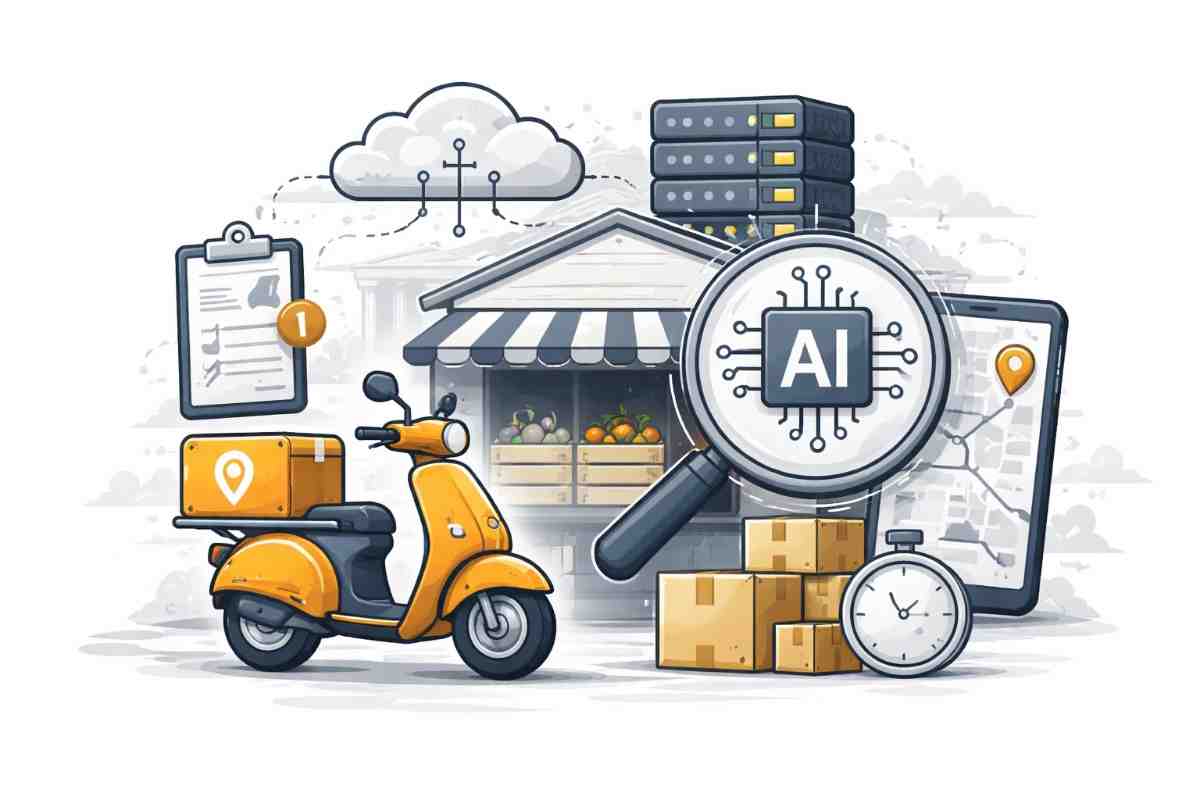
Food delivery major Swiggy has partnered with Google Cloud to strengthen its supply chain using artificial intelligence, marking a major step in how large consumer platforms manage scale, speed, and efficiency.
The collaboration is aimed at improving demand forecasting, inventory planning, and last-mile operations across Swiggy’s fast-growing network.
The move comes as India’s online food and quick commerce markets become more competitive, with companies under pressure to deliver faster while controlling costs.


Why This Partnership Matters Today
India’s food delivery and quick commerce sector is running on thin margins and high expectations.
Customers want faster delivery, fewer cancellations, and better availability. At the same time, platforms need to reduce waste, manage dark stores efficiently, and handle sudden demand spikes.
By bringing AI deeper into its supply chain, Swiggy is signalling that technology-led operations will define the next phase of growth.
Who Is Involved in the Partnership
The collaboration brings together two major players.
Swiggy is one of India’s largest food delivery and quick commerce platforms, operating across hundreds of cities.
Google Cloud provides cloud infrastructure, data analytics, and AI tools to global enterprises.
Together, they aim to build smarter, more responsive supply chain systems.
What Swiggy Plans to Achieve with AI
The focus of the partnership is supply chain intelligence.
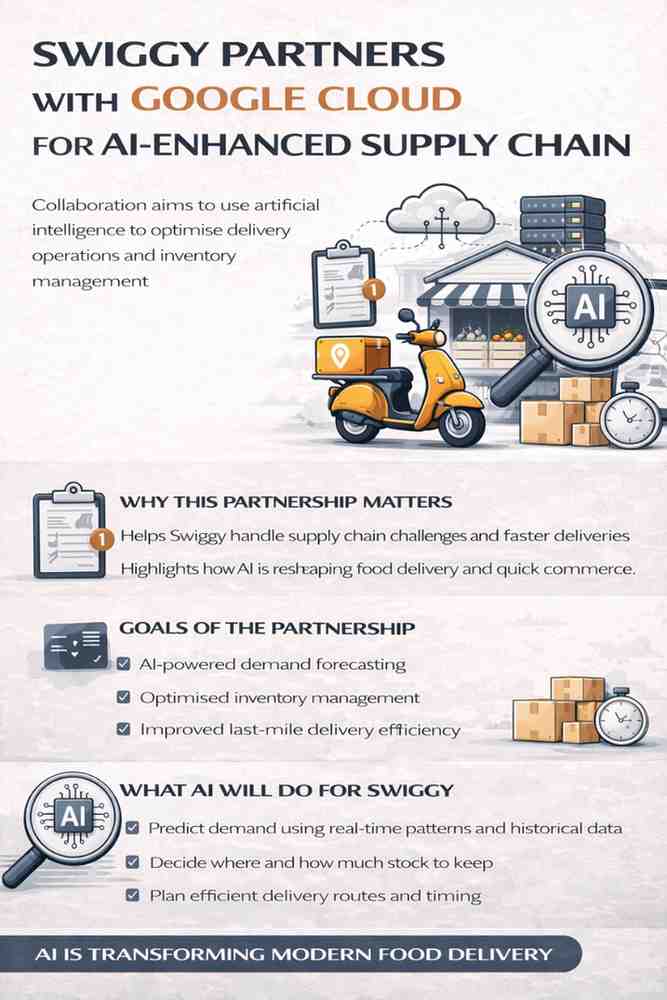
Swiggy plans to use AI and machine learning to predict demand more accurately, reduce stock-outs, and optimise delivery routes.
Better forecasting helps the platform ensure that popular items are available when customers order, especially during peak hours, weekends, and festivals.
How AI Will Improve Demand Forecasting
Demand in food delivery can change sharply based on weather, events, time of day, and local preferences.
Using Google Cloud’s AI tools, Swiggy can analyse large volumes of historical and real-time data to spot patterns. This allows the system to prepare for sudden surges without overstocking.
More accurate forecasts also help partner restaurants and dark stores plan better.
Impact on Swiggy’s Quick Commerce Operations
Swiggy’s quick commerce arm relies heavily on efficient supply chains.
AI-driven planning can help decide what products should be stocked, in which location, and in what quantity. This reduces waste and improves delivery success rates.
For customers, this means higher chances of getting what they order within promised time slots.
Smarter Inventory and Lower Wastage
Inventory mismanagement is costly in food and grocery delivery.
Overstocking leads to spoilage, while understocking leads to lost orders.
AI models can balance this by learning consumption patterns and adjusting inventory levels dynamically. This is especially important for fresh items with short shelf lives.
Role of Google Cloud Technology
Google Cloud offers scalable computing power and advanced data analytics.
Its AI platforms allow companies to process vast datasets quickly and run complex models in real time. For Swiggy, this means faster insights and quicker operational decisions.
Cloud-based systems also support growth without the need for heavy physical infrastructure.
Improving Last-Mile Delivery Efficiency
Last-mile delivery is one of the most expensive parts of the supply chain.
AI can help optimise delivery routes, cluster orders better, and reduce idle time for delivery partners. This improves speed while lowering fuel and operational costs.
More efficient routing also supports better service during traffic congestion and adverse weather.
What This Means for Swiggy’s Delivery Partners
Better supply chain planning can improve delivery partner experience.
With fewer last-minute changes and clearer demand signals, delivery partners can see more predictable order flows. Reduced cancellations and delays also help improve earnings stability.
Benefits for Restaurant and Merchant Partners
Restaurant partners benefit from improved demand visibility.
AI-driven insights can help them plan preparation, staffing, and raw material procurement. This reduces stress during peak hours and improves order fulfilment rates.
Merchants connected to Swiggy’s quick commerce network also gain from smoother inventory movement.
How This Fits into Swiggy’s Long-Term Strategy
Swiggy has been steadily investing in technology to improve unit economics.
From logistics to pricing and customer experience, data-led decision-making has become central to its strategy.
The Google Cloud partnership strengthens Swiggy’s backend systems rather than focusing only on front-end features.
Competitive Landscape in Food and Quick Commerce
The food delivery and quick commerce space in India is intensely competitive.
Platforms are racing to offer faster deliveries, broader selections, and better reliability. Technology partnerships like this one are becoming key differentiators.
AI-backed supply chains can provide a long-term edge that is hard to replicate quickly.
Industry Trend: AI in Consumer Supply Chains
Globally, consumer platforms are using AI to manage complexity.
From retail to logistics, companies are turning to cloud-based AI systems to handle scale without linear cost increases. Swiggy’s move reflects this wider industry shift.
Data Security and Reliability
Cloud partnerships also raise questions around data handling.
Google Cloud operates under global security standards, and Swiggy has stated that customer and business data will be handled securely. Reliability and uptime are critical for large-scale operations.
What Customers Can Expect
For customers, the changes may not be immediately visible, but the impact will be felt over time.
Better availability, fewer cancelled orders, and more consistent delivery times are expected as systems mature.
During high-demand periods, AI-backed planning can help prevent service breakdowns.
What Comes Next
The partnership is expected to evolve in phases.
Initial focus is on supply chain optimisation, but further use cases may include personalised recommendations, smarter pricing, and deeper analytics across Swiggy’s ecosystem.
No financial details of the partnership have been disclosed.
Why This Is a Significant Move
This collaboration shows how food delivery platforms are becoming technology-driven operations companies.
Success is no longer just about acquiring users but about running complex systems efficiently at scale.
AI-enhanced supply chains are emerging as a critical foundation for sustainable growth.
Big Picture
Swiggy’s partnership with Google Cloud reflects a broader shift in Indian consumer tech.
As platforms grow, backend intelligence becomes as important as customer-facing apps. AI, data, and cloud infrastructure are now central to competitiveness.
Bottom Line
Swiggy’s partnership with Google Cloud to build an AI-enhanced supply chain marks a strategic step towards smarter, more efficient operations.
By using artificial intelligence to manage demand, inventory, and delivery, the company aims to improve reliability while controlling costs.
In a crowded and fast-moving market, technology-led supply chains could determine which platforms lead and which fall behind.
Disclaimer: The information presented in this article is intended for general informational purposes only. While every effort is made to ensure accuracy, completeness, and timeliness, data such as prices, market figures, government notifications, weather updates, holiday announcements, and public advisories are subject to change and may vary based on location and official revisions. Readers are strongly encouraged to verify details from relevant official sources before making financial, investment, career, travel, or personal decisions. This publication does not provide financial, investment, legal, or professional advice and shall not be held liable for any losses, damages, or actions taken in reliance on the information provided.
Last Updated on Tuesday, February 10, 2026 7:02 am by Startup Newswire Team