
Spinny Raises $170 Million in Series G Round as India’s Used-Car Market Shows Strong Recovery
India’s online used-car platform Spinny has raised $170 million in a Series G funding round, marking one of the largest recent capital infusions in the country’s pre-owned vehicle segment.
The funding comes at a time when India’s used-car market is witnessing renewed demand. Rising new car prices, longer waiting periods for certain models, and improving consumer confidence are driving buyers toward certified pre-owned vehicles.
The fresh capital signals investor belief in the long-term potential of India’s organised used-car ecosystem.
Key Details of the Series G Funding Round
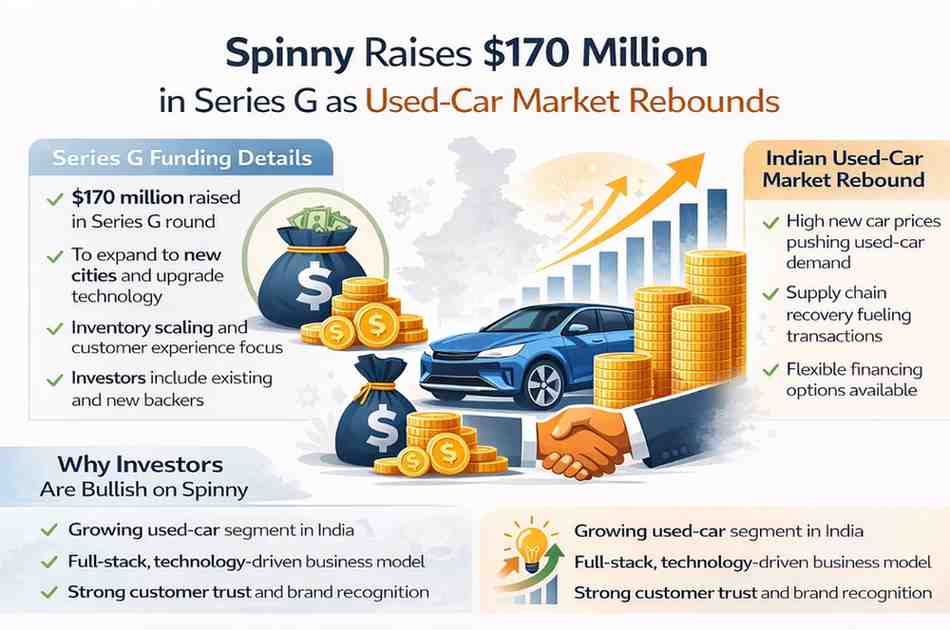
Spinny confirmed that it secured $170 million in its latest Series G round. The funding includes participation from existing and new investors, reflecting continued confidence in the company’s business model.
The company has not indicated any immediate change in its core operations. However, the fresh funds are expected to support:
- Expansion into new cities
- Technology upgrades
- Inventory scaling
- Strengthening refurbishment capabilities
- Enhancing customer experience
Spinny has raised multiple rounds in the past as it built its position in India’s competitive online car marketplace.
Why This Funding Matters Now
The used-car market in India is entering a growth phase.
Industry data from auto research bodies suggests that used-car transactions in India have been growing faster than new car sales in recent years. Analysts estimate that for every new car sold, more than one used car changes hands.
Several factors are driving this rebound:
- High new vehicle prices
- Supply chain constraints in the past
- Increased financing availability
- Growing acceptance of digital car buying
Spinny’s Series G round reflects investor confidence that the organised used-car sector still has room to grow.
India’s Used-Car Market: A Rapidly Expanding Segment
India’s used-car market has traditionally been fragmented. Local dealers dominated transactions for decades.
However, online platforms have changed consumer behaviour.
Companies such as Cars24 and CarDekho have also built digital marketplaces that offer inspection, documentation, and financing services.
Buyers now prefer:
- Transparent pricing
- Vehicle history checks
- Warranty options
- Doorstep delivery
Organised players provide certified vehicles, which increases buyer trust.
Spinny’s Business Model
Founded in 2015, Spinny operates a full-stack model. It purchases used cars, refurbishes them, and sells them directly to consumers.
The company emphasises:
- Quality checks
- Standardised pricing
- Fixed price model
- Return options
- Warranty support
This approach differs from classified platforms that only connect buyers and sellers.
Spinny also operates experience hubs in multiple cities where customers can physically inspect vehicles.
Used-Car Demand Trends in India
The rebound in used-car demand has been visible across major cities.
Urban buyers often choose pre-owned cars because:
- They offer better value for money
- Insurance costs may be lower
- Depreciation is slower compared to new vehicles
First-time car buyers and young professionals are significant contributors to growth.
Smaller cities are also showing rising interest as financing becomes more accessible.
Investor Confidence in Auto-Tech Platforms
The funding environment for startups has tightened in recent years. However, capital continues to flow into companies with strong fundamentals.
Spinny’s ability to raise $170 million suggests:
- Investor confidence in revenue potential
- Strong demand in the used-car segment
- Belief in long-term scalability
Auto-tech platforms operate in a large addressable market. India’s growing middle class supports vehicle ownership expansion.
Competition in the Online Used-Car Space
The sector remains competitive.
Besides Spinny, platforms like Cars24 and traditional dealer networks continue to operate aggressively.
Competition centres around:
- Pricing transparency
- Delivery timelines
- Warranty coverage
- Customer service
Consolidation may occur over time as players seek profitability.
Customer trust remains the most important factor in used-car sales.
Financing and Digital Integration
Digital financing has played a major role in boosting used-car sales.
Many online platforms now offer:
- Instant loan approvals
- Digital KYC
- Integrated insurance
- EMI calculators
Banks and NBFCs are partnering with auto-tech firms to simplify car financing.
This integration reduces friction and speeds up transactions.
Technology and Data Advantage
Spinny and similar platforms rely heavily on data.
Data analytics help in:
- Pricing vehicles accurately
- Predicting demand
- Managing inventory
- Minimising depreciation losses
AI-driven tools assist in vehicle inspection and listing processes.
Technology reduces operational inefficiencies and improves margins.
Challenges Facing the Sector
Despite strong growth, the used-car industry faces challenges.
These include:
- Inventory sourcing
- Maintaining refurbishment standards
- Balancing growth with profitability
- Handling fluctuating demand
The sector is capital-intensive due to inventory holding costs.
Companies must manage working capital carefully.
Used-Car Market vs New-Car Market
The used-car segment often performs well during economic uncertainty.
When new car prices rise, consumers shift to pre-owned options.
The rebound in used-car demand reflects price sensitivity in the market.
At the same time, new car waiting periods during past supply disruptions pushed many buyers toward used vehicles.
The organised used-car market is expected to continue expanding as consumer trust grows.
Spinny’s Expansion Strategy
With fresh capital, Spinny may expand its presence across tier-2 and tier-3 cities.
The company has already established operations in major metro areas.
Expanding to smaller cities could unlock additional demand.
Improving refurbishment infrastructure and logistics networks may also be part of its growth strategy.
Impact on India’s Startup Ecosystem
Large funding rounds like this send a positive signal to India’s startup ecosystem.
They show that:
- Investors still back strong consumer businesses
- Digital marketplaces remain attractive
- Organised sectors are replacing fragmented markets
The funding also highlights continued interest in mobility-focused startups.
What This Means for Consumers
For car buyers, increased competition among platforms could mean:
- Better pricing transparency
- Improved service standards
- Wider vehicle selection
- Attractive financing options
Organised used-car platforms aim to make the buying process smoother than traditional dealer experiences.
Consumers now expect convenience similar to e-commerce platforms.
Conclusion: A Strong Bet on Used-Car Growth
Spinny’s $170 million Series G funding reflects strong investor confidence in India’s used-car market rebound.
The shift toward organised digital platforms continues to reshape how Indians buy and sell pre-owned vehicles.
While competition remains intense, the long-term outlook for the sector appears stable due to rising demand and increasing digital adoption.
As new vehicle prices remain high and consumers prioritise value, the used-car segment could remain a major growth engine in India’s automotive industry.
Spinny’s latest funding round positions it to compete strongly in this evolving market and underscores that the rebound in used-car demand is not temporary, but structural.
Disclaimer: The information presented in this article is intended for general informational purposes only. While every effort is made to ensure accuracy, completeness, and timeliness, data such as prices, market figures, government notifications, weather updates, holiday announcements, and public advisories are subject to change and may vary based on location and official revisions. Readers are strongly encouraged to verify details from relevant official sources before making financial, investment, career, travel, or personal decisions. This publication does not provide financial, investment, legal, or professional advice and shall not be held liable for any losses, damages, or actions taken in reliance on the information provided.
Last Updated on Tuesday, February 24, 2026 6:40 am by Startup Newswire Team
About The Author