


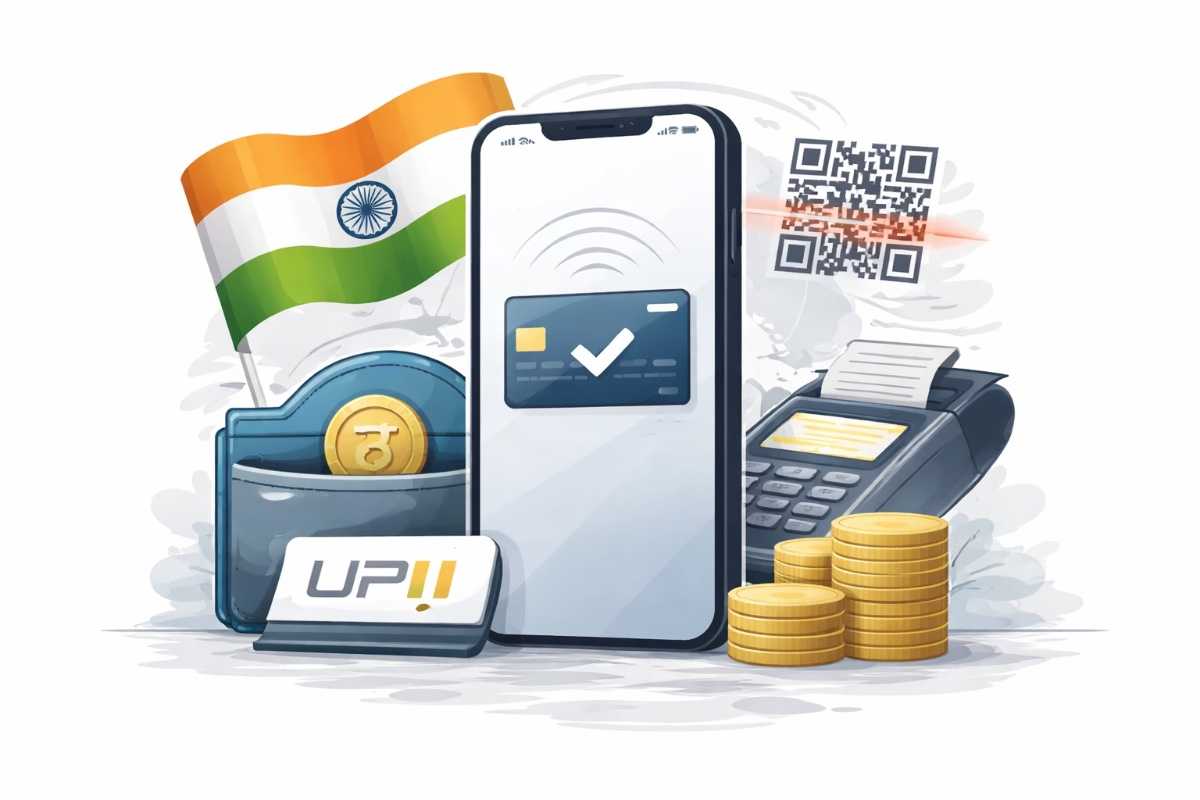
Apple Exploring India Entry for Apple Pay as Digital Payments Market Expands
Technology giant Apple Inc. is reportedly in discussions to bring its digital payments service, Apple Pay, to India by mid-2026. The move, if finalised, would mark Apple Pay’s official entry into one of the world’s fastest-growing digital payments markets.
India’s fintech ecosystem has expanded rapidly over the past decade, driven by smartphone penetration, Unified Payments Interface (UPI) adoption, and government-backed digital initiatives. Apple’s entry could reshape competition in premium smartphone-based payments and strengthen its broader ecosystem in the country.


While no official launch date has been announced, industry discussions suggest that Apple is exploring regulatory approvals and local partnerships required to operate in India.
Here is a detailed look at what this development means for Indian consumers, banks, fintech players, and the digital payments sector.
What Is Apple Pay?
Apple Pay is Apple’s contactless payment and digital wallet service. It allows users to:
- Make in-store payments using NFC-enabled terminals
- Pay online through apps and websites
- Store debit and credit cards securely
- Authorise payments using Face ID or Touch ID
The service is already active in multiple countries, including the United States, the United Kingdom, and parts of Asia-Pacific.
If launched in India, Apple Pay would need to integrate with local payment infrastructure, especially UPI and card networks.
Why India Is a Strategic Market for Apple
India has become a priority market for Apple in recent years.
Growing iPhone User Base
Apple has expanded its presence in India through:
- Local manufacturing
- Official retail stores
- Increased distribution
- Premium financing options
With iPhone shipments rising steadily, Apple may see payments as the next logical step in deepening its ecosystem.
Digital Payments Boom
India’s digital payments sector is among the largest globally.
Key drivers include:
- Unified Payments Interface (UPI)
- Widespread QR code adoption
- Rapid merchant digitisation
- Government-backed digital infrastructure
Any global tech firm entering this space must align with India’s regulatory framework and payment architecture.
Regulatory Landscape for Digital Payments in India
For Apple Pay to operate in India, it must comply with regulations set by the Reserve Bank of India (RBI).
Key regulatory requirements may include:
- Data localisation norms
- Tokenisation guidelines
- Payment aggregator rules
- UPI interoperability standards
The RBI has strict oversight over digital payment platforms. Any international entrant must secure necessary approvals and align with India’s payment security norms.
Will Apple Pay Support UPI?
One of the most important questions is whether Apple Pay will integrate with India’s UPI system.
UPI, developed by the National Payments Corporation of India, has become the backbone of India’s digital payments ecosystem.
Most Indian users rely on UPI apps such as:
- Google Pay
- PhonePe
- Paytm
If Apple Pay enters India, industry experts expect it to offer UPI compatibility to compete effectively.
Without UPI integration, Apple Pay may remain limited to card-based transactions, which have lower transaction volume compared to UPI.
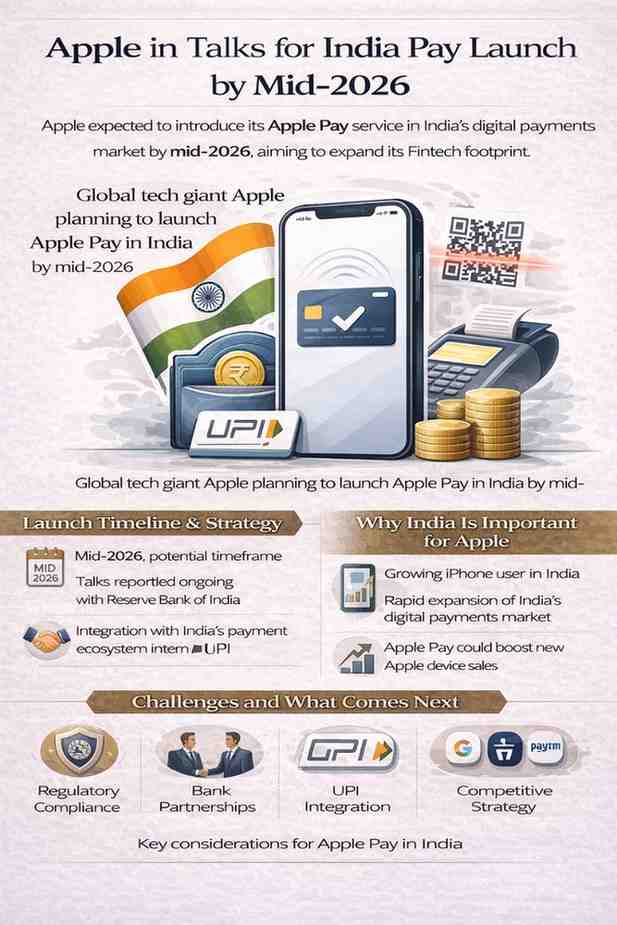
How Apple Pay Could Compete in India
India’s digital payments space is highly competitive.
Strengths Apple Brings
- Strong brand loyalty among iPhone users
- Seamless hardware and software integration
- Focus on privacy and security
- Global payment experience
Challenges Ahead
- UPI dominance by existing apps
- Regulatory compliance complexity
- Merchant adoption
- Limited iPhone market share compared to Android
Apple’s share of India’s overall smartphone market remains smaller than Android. However, it commands a significant share in the premium segment.
Apple Pay may initially target urban, high-income consumers.
Security and Privacy Focus
Apple Pay markets itself globally as a privacy-first payment solution.
Key security features include:
- Tokenised card numbers
- Biometric authentication
- No sharing of actual card details with merchants
In India, digital payment security remains a key concern for users.
If Apple emphasises data privacy and secure transactions, it may attract users seeking additional protection.
Impact on Indian Fintech Players
The entry of a global tech giant like Apple could increase competition in the digital wallet space.
However, UPI apps currently dominate transaction volumes.
Indian fintech players have deep integration with:
- Local banks
- Government schemes
- Utility bill systems
- Merchant networks
Apple would need strong partnerships with Indian banks and payment processors to scale effectively.
Bank Partnerships: A Key Requirement
For Apple Pay to function in India, it must partner with:
- Major Indian banks
- Card networks such as Visa and Mastercard
- Possibly RuPay, India’s domestic card network
Bank support is critical because Apple Pay relies on linking debit and credit cards to the wallet.
Without broad bank participation, adoption may remain limited.
Mid-2026 Timeline: What It Suggests
Reports indicating a mid-2026 launch timeline suggest that discussions are still ongoing.
Launching a payment service in India involves:
- Regulatory clearances
- Infrastructure testing
- Bank integration
- Merchant onboarding
The timeline reflects the complexity of entering a mature and highly regulated payments ecosystem.
Apple’s Larger India Strategy
Apple has gradually increased its investment in India through:
- Manufacturing partnerships
- Retail store expansion
- Services ecosystem growth
Introducing Apple Pay could:
- Strengthen Apple’s services revenue
- Enhance ecosystem stickiness
- Encourage more iPhone upgrades
Apple’s long-term strategy appears focused on expanding beyond hardware sales.
Consumer Perspective: What Could Change?
If Apple Pay launches successfully in India, iPhone users could benefit from:
- Contactless NFC payments
- In-app payments without third-party apps
- Seamless Apple ecosystem integration
However, widespread adoption will depend on:
- UPI compatibility
- Merchant acceptance
- Competitive incentives
Global Context of Apple Pay
Apple Pay operates in more than 70 countries globally.
In many markets, it competes with:
- Google Pay
- Samsung Pay
- Local digital wallets
India represents a different challenge due to UPI’s scale and regulatory framework.
What Happens Next?
As of now:
- No official confirmation of launch date
- Discussions reportedly ongoing
- Regulatory processes yet to be completed
Consumers and industry stakeholders will watch for announcements from Apple and regulators in the coming months.
Conclusion: A Potential Game-Changer, but Challenges Remain
Apple’s reported talks to launch Apple Pay in India by mid-2026 signal growing interest in the country’s digital payments sector.
If successful, Apple Pay could introduce new competition in the premium payments segment and enhance Apple’s services ecosystem.
However, success will depend on:
- Regulatory approval
- UPI integration
- Bank partnerships
- Merchant adoption
India’s digital payments market is already highly competitive and mature. Apple’s entry would add a new dimension, but the company will need to adapt to India’s unique payment landscape.
Further updates are expected as official announcements are made.
For now, the possibility of Apple Pay’s India launch remains a significant development for the country’s fintech ecosystem.
Disclaimer: The information presented in this article is intended for general informational purposes only. While every effort is made to ensure accuracy, completeness, and timeliness, data such as prices, market figures, government notifications, weather updates, holiday announcements, and public advisories are subject to change and may vary based on location and official revisions. Readers are strongly encouraged to verify details from relevant official sources before making financial, investment, career, travel, or personal decisions. This publication does not provide financial, investment, legal, or professional advice and shall not be held liable for any losses, damages, or actions taken in reliance on the information provided.
Last Updated on Friday, February 27, 2026 12:01 pm by Startup Newswire Team