
Oncare Raises ₹27 Crore in Series A to Expand Affordable Cancer Care Network Across India
Healthcare startup Oncare has raised ₹27 crore in a Series A funding round, marking a significant step in its plan to expand affordable cancer treatment services in India.
The fresh capital comes at a time when access to quality oncology care remains uneven across the country. Rising cancer cases, high treatment costs, and limited specialised centres in smaller cities have created a pressing need for scalable and affordable care models.
Oncare’s Series A round reflects growing investor interest in healthcare startups focused on addressing India’s treatment gaps.
Funding Details and Expansion Plans
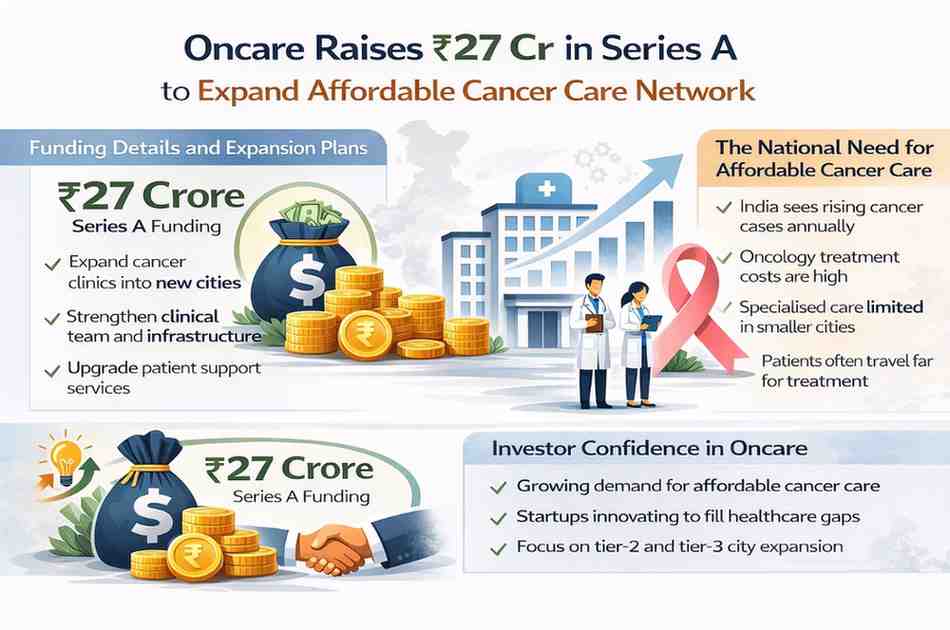
Oncare confirmed that it secured ₹27 crore in its Series A round. The company plans to use the funds to:
- Expand its cancer care clinics into new cities
- Strengthen its clinical team
- Upgrade medical infrastructure
- Enhance patient support services
- Improve technology systems for care coordination
The startup operates a network model that aims to make cancer treatment more accessible and affordable for patients outside major metro cities.
The funding will help accelerate its growth strategy.
Why Affordable Cancer Care Is a National Priority
Cancer remains one of India’s leading health concerns.
According to data from the Indian Council of Medical Research, cancer cases in India have been steadily rising over the years.
Treatment often involves:
- Surgery
- Chemotherapy
- Radiation therapy
- Long-term follow-ups
These services are expensive and concentrated in large urban hospitals.
Patients from smaller towns frequently travel long distances to receive care. This increases both financial and emotional stress.
Affordable and decentralised oncology networks are seen as a potential solution.
Oncare’s Care Delivery Model
Oncare focuses on building specialised oncology clinics that aim to deliver quality treatment at controlled costs.
The company’s approach includes:
- Standardised treatment protocols
- Partnerships with oncologists
- Cost transparency
- Integrated diagnostic support
By reducing overhead costs compared to large corporate hospitals, the startup aims to offer competitive pricing.
The model seeks to maintain clinical standards while improving affordability.
Investor Confidence in Healthcare Startups
Healthcare technology and service startups have attracted steady investor attention in India.
The COVID-19 pandemic accelerated digital health adoption and highlighted gaps in healthcare infrastructure.
Investors are now focusing on:
- Specialised treatment networks
- Preventive care
- Digital health platforms
- Affordable service models
Oncare’s ₹27 crore funding round reflects continued belief in scalable healthcare solutions.
The Growing Burden of Cancer in India
India’s cancer burden is increasing due to:
- Ageing population
- Lifestyle changes
- Tobacco use
- Environmental factors
Common cancers in India include:
- Breast cancer
- Lung cancer
- Cervical cancer
- Oral cancer
Early diagnosis and timely treatment significantly improve survival rates.
However, affordability and accessibility remain barriers for many families.
Challenges in India’s Oncology Ecosystem
Despite improvements in healthcare infrastructure, several challenges persist:
- Limited oncology specialists in smaller towns
- High cost of advanced therapies
- Uneven distribution of radiation facilities
- Delays in diagnosis
Private corporate hospitals dominate specialised oncology care in large cities.
Public hospitals offer services at lower costs but often face high patient load.
Startups like Oncare aim to bridge this gap by creating structured, mid-cost care networks.
Expansion into Tier-2 and Tier-3 Cities
One of the key objectives of Oncare’s Series A funding is geographic expansion.
Tier-2 and tier-3 cities often lack comprehensive cancer centres.
Patients may travel to metros like Mumbai, Delhi, Chennai or Bengaluru for advanced treatment.
Building regional oncology centres can reduce:
- Travel costs
- Treatment delays
- Patient stress
Expanding into smaller cities also improves early-stage detection and regular follow-up care.
Technology Integration in Cancer Care
Digital tools are increasingly shaping healthcare delivery.
Oncare plans to strengthen its technology systems to improve:
- Electronic medical records
- Appointment management
- Treatment tracking
- Patient communication
Technology helps ensure consistency in treatment protocols across centres.
It also allows remote consultations and coordinated care between specialists.
Cost Transparency and Patient Trust
Cancer treatment expenses can be unpredictable.
One of the major concerns among patients is unexpected billing.
Healthcare startups are focusing on clear pricing models and treatment plans.
Transparent cost structures improve trust and reduce anxiety.
Affordable care does not mean compromised quality. It requires operational efficiency and careful cost management.
Role of Public and Private Collaboration
India’s healthcare system depends on both public and private players.
Private oncology networks complement government initiatives.
The government has launched schemes such as Ayushman Bharat to improve healthcare access.
However, private networks still play a critical role in specialised treatments.
Affordable cancer care startups operate within this ecosystem to expand reach.
What This Funding Means for Patients
The ₹27 crore investment could result in:
- More accessible oncology clinics
- Reduced waiting times
- Structured treatment pathways
- Improved local care availability
For patients, especially in smaller cities, this expansion could mean receiving treatment closer to home.
Reduced travel and accommodation expenses significantly lower overall treatment costs.
Competitive Landscape in Oncology Care
India has several large hospital chains offering cancer treatment.
However, specialised, mid-sized oncology networks remain limited.
Startups entering this space must maintain:
- Strong clinical governance
- Qualified oncologists
- High safety standards
Competition will likely increase as healthcare demand grows.
Quality and patient outcomes will remain critical performance indicators.
Sustainable Growth in Healthcare Startups
Healthcare expansion requires careful planning.
Unlike e-commerce or consumer startups, medical networks must meet strict regulatory and safety standards.
Expansion plans must consider:
- Doctor availability
- Equipment procurement
- Compliance requirements
- Patient safety protocols
Series A funding often supports scaling operations while strengthening governance systems.
Conclusion: A Step Toward More Accessible Oncology Care
Oncare’s ₹27 crore Series A funding round highlights rising investor confidence in affordable cancer care models.
With cancer cases increasing across India, expanding specialised treatment networks is essential.
The startup’s focus on cost transparency, regional expansion, and structured care delivery could improve access for many families.
However, success will depend on maintaining medical quality while scaling operations.
As India works to strengthen its healthcare infrastructure, investments in oncology networks could play a meaningful role in improving patient outcomes.
Affordable, accessible cancer care remains a national need and this funding round marks another step in that direction.
Disclaimer: The information presented in this article is intended for general informational purposes only. While every effort is made to ensure accuracy, completeness, and timeliness, data such as prices, market figures, government notifications, weather updates, holiday announcements, and public advisories are subject to change and may vary based on location and official revisions. Readers are strongly encouraged to verify details from relevant official sources before making financial, investment, career, travel, or personal decisions. This publication does not provide financial, investment, legal, or professional advice and shall not be held liable for any losses, damages, or actions taken in reliance on the information provided.
Last Updated on Tuesday, February 24, 2026 6:49 am by Startup Newswire Team
About The Author