


India’s startup funding ecosystem is entering a more mature phase — one where liquidity, exits, and secondary transactions are becoming as important as fresh capital deployment.
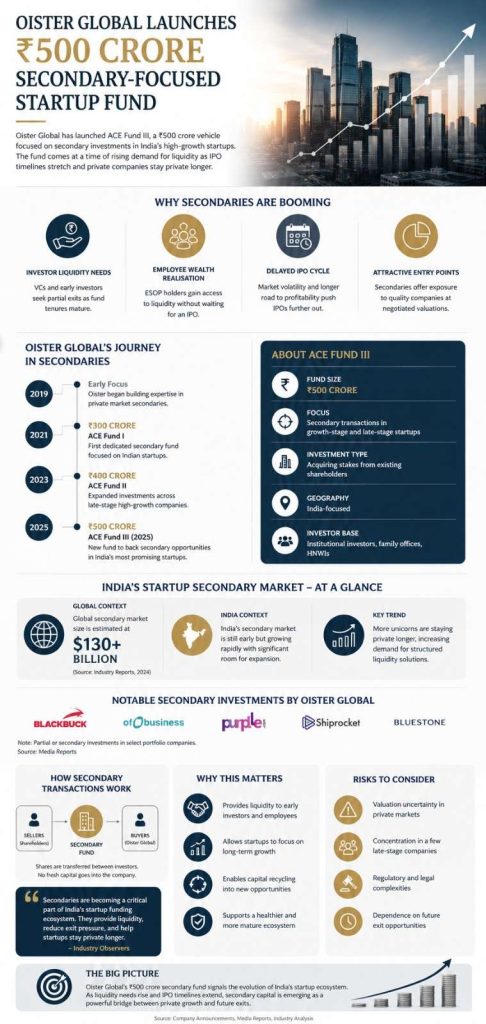
Against this backdrop, investment firm Oister Global has launched ACE Fund III, a ₹500 crore secondary-focused investment vehicle aimed at acquiring stakes in high-growth Indian startups from existing shareholders. The launch reflects a broader structural shift underway in India’s private markets, where delayed IPO timelines and longer holding periods are increasing demand for secondary liquidity solutions.


The Gurugram-based firm has steadily expanded its presence in India’s startup secondary market over the past few years, positioning itself as a specialist in a segment that was once considered niche but is now becoming increasingly mainstream.
Why Startup Secondaries Are Suddenly in Focus
For much of the last decade, Indian venture capital operated on a growth-first model. Investors poured capital into startups with the expectation that IPOs or strategic acquisitions would eventually deliver returns.
But the market dynamics have shifted.
Public market volatility, tighter capital conditions, valuation resets, and delayed listings have stretched exit timelines for early investors. As a result, secondary transactions — where existing shares are sold between investors without injecting fresh capital into the company — are becoming a critical liquidity mechanism.
Oister Global’s new fund arrives at a time when startup founders, early employees, angel investors, and venture capital firms are increasingly seeking partial exits without waiting for public listings.
According to reports, Oister has already deployed more than ₹1,000 crore over the last two years across secondary transactions involving startups such as BlackBuck, OfBusiness, Purplle, Shiprocket, and BlueStone.
The firm’s earlier secondary-focused funds reportedly included a ₹300 crore first vehicle followed by a ₹400 crore second fund before the newly launched ACE Fund III.
Understanding the Rise of India’s Secondary Market
India’s startup ecosystem is no longer a purely early-stage market. A growing number of companies are now reaching late-stage maturity while remaining private for longer periods.
This transition is creating several structural changes:
1. Investors Need Liquidity Before IPOs
Many venture capital firms that invested during the 2017–2021 funding boom are approaching the end of their fund cycles. Limited partners increasingly expect distributions and realised returns.
Secondary sales offer a practical path to partial liquidity.
2. Employees Want Wealth Realisation
Startup ESOP holders often remain paper-rich for years without meaningful liquidity events. Secondary transactions allow companies to reward employees without pursuing premature public listings.
3. Mature Startups Are Staying Private Longer
Several Indian unicorns now prefer delaying IPOs until profitability metrics improve or public market conditions stabilise. That naturally extends investor holding periods.
4. New Investors Want Discounted Entry
Secondary buyers often acquire shares at negotiated discounts compared to peak private-market valuations. This creates opportunities for funds specialising in structured secondary deals.
Industry observers note that India’s secondary ecosystem still remains significantly smaller than mature markets like the United States, but momentum is accelerating rapidly.
A 2024 report cited by industry publications estimated that global secondary markets exceed $130 billion, while India’s market remains in an early-growth phase with substantial room for expansion.
Oister Global’s Strategy: Focused Exposure Rather Than Broad Venture Investing
Unlike traditional venture capital firms that primarily invest fresh capital into startups, Oister’s model is built around acquiring existing stakes from shareholders seeking liquidity.
The firm positions itself as an alternative assets manager focused on private markets, secondaries, feeder funds, and co-investments. According to the company, it has deployed over $700 million across private-market asset classes and operates multiple investment vehicles.
Its secondary funds have largely concentrated on growth-stage and late-stage startups that already demonstrate stronger operating metrics, market leadership, or potential IPO readiness.
This approach reflects a broader evolution in India’s private capital ecosystem:
- Early-stage venture capital remains abundant in select sectors
- Growth-stage capital has become more selective
- Exit pathways are being diversified beyond IPOs
- Liquidity management is emerging as a core institutional theme
For investors, secondary-focused funds also provide relatively lower duration risk compared to traditional early-stage venture investing.
The Delayed IPO Effect on India’s Startup Ecosystem
One of the biggest drivers behind the secondary boom is the slowdown in startup IPO activity compared to the euphoric 2021 cycle.
After several high-profile tech listings faced post-IPO volatility, both founders and investors became more cautious about public-market timing. Many startups have since shifted focus toward profitability, governance improvements, and operational discipline.
This has created a holding-period extension across the venture ecosystem.
Instead of expecting exits within five to seven years, investors are increasingly preparing for longer timelines. Secondary transactions are helping bridge that gap.
The trend is particularly visible in large private startups where institutional shareholders periodically rebalance exposure.
Deals involving companies such as Lenskart, Meesho, Urban Company, and Shadowfax have highlighted the growing appetite for structured secondary liquidity in India’s late-stage startup ecosystem.
India’s Startup Market Is Becoming More Institutionally Mature
The emergence of specialised secondary funds signals a broader institutional maturation of Indian venture capital.
Historically, India’s startup ecosystem focused heavily on funding rounds and valuation growth. Today, conversations are increasingly centred around:
- exit quality
- liquidity cycles
- governance
- sustainable returns
- portfolio recycling
- secondary ownership structures
This shift resembles patterns seen in more mature startup ecosystems globally.
The rise of secondary-focused capital pools may also help reduce pressure on startups to pursue premature IPOs simply to provide investor liquidity.
Instead, companies can remain private longer while allowing shareholders to partially exit through structured transactions.
Competition in the Secondary Investment Space Is Increasing
Oister Global is not alone in identifying this opportunity.
Several domestic and global investment firms have begun building dedicated secondary strategies in India. The segment has attracted growing institutional attention as startup portfolios mature and liquidity needs intensify.
In 2024, Oister Global also partnered with Tribe Capital’s India arm to launch a larger India-focused secondary investment platform targeting up to $500 million in deployments over two years.
Other investors, including dedicated secondaries specialists and alternative asset managers, are increasingly entering the space as transaction volumes rise.
The market opportunity could expand further if India witnesses a stronger IPO cycle over the next few years, creating more benchmark pricing for private technology companies.
Risks Still Remain in the Secondary Market
Despite growing optimism, startup secondaries remain a relatively complex asset class.
Several risks persist:
Valuation Uncertainty
Private-market pricing remains less transparent than public equities, especially during periods of macroeconomic volatility.
Liquidity Concentration
Most large secondary deals continue to involve a relatively small group of late-stage startups.
Regulatory Complexity
Secondary transactions in private companies often involve shareholder approvals, transfer restrictions, and legal structuring complexities.
Exit Timing Risk
Even secondary buyers ultimately depend on future IPOs, strategic acquisitions, or further secondary sales for eventual returns.
As a result, disciplined underwriting and careful company selection remain critical.
What Oister’s New Fund Signals for Indian Startups
The launch of ACE Fund III is less about one firm raising another investment vehicle and more about what it says regarding the evolution of India’s startup economy.
India’s venture ecosystem is increasingly moving from a capital formation story to a capital recycling story.
That distinction matters.
A healthy startup ecosystem requires not just funding inflows, but also predictable liquidity mechanisms that reward early risk-taking and recycle capital into newer ventures.
Secondary markets can play a central role in enabling that transition.
If India’s startup sector continues maturing into a long-duration private-market ecosystem, specialised secondary investors may become as important as traditional venture capital firms over the coming decade.
Conclusion
Oister Global’s ₹500 crore secondary-focused fund underscores the changing priorities within India’s startup financing landscape.
As IPO timelines lengthen and venture portfolios mature, liquidity solutions are becoming a critical layer of the ecosystem. Secondary funds are increasingly emerging as a bridge between long-term private ownership and eventual public-market exits.
For founders, employees, and early investors, that evolution could bring greater flexibility and financial optionality. For institutional investors, it may open a new avenue for structured exposure to India’s next generation of mature technology companies.
The broader significance lies in what this signals about the Indian startup ecosystem itself: it is no longer just expanding — it is beginning to institutionalise.
Also Read : India’s New B2B Startup Wave Is Being Built Outside Traditional Tech Hubs
Last Updated on Wednesday, May 20, 2026 1:13 pm by Startup Newswire Team