
Groq Targets $650 Million Fundraise After Nvidia Partnership as AI Inference Race Intensifies
The artificial intelligence infrastructure market is entering a new phase—one where inference, rather than model training, is increasingly becoming the industry’s most commercially significant battleground.
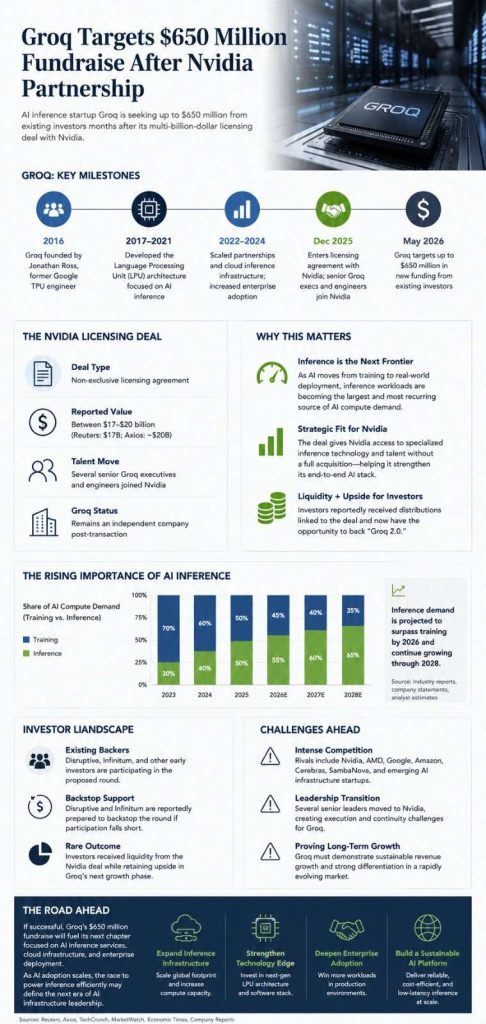
Against that backdrop, AI chip startup Groq is reportedly seeking to raise up to $650 million from existing investors following its high-profile licensing agreement with Nvidia, a transaction that reshaped both companies’ positions in the rapidly evolving AI hardware ecosystem. Reports from Reuters and Axios indicate that the fundraising effort comes months after Groq entered into a major licensing arrangement with Nvidia that involved technology access and the movement of senior Groq leadership to Nvidia.
The fundraising effort offers a rare glimpse into how AI infrastructure startups are adapting after strategic partnerships with industry giants. More importantly, it highlights a broader shift across the semiconductor industry: the growing value of AI inference infrastructure as enterprises move from experimenting with AI models to deploying them at scale.
A New Chapter for Groq
Groq was founded in 2016 by Jonathan Ross, a former Google engineer who helped develop Google’s Tensor Processing Unit (TPU). The company became known for designing specialized processors aimed at accelerating AI workloads through its Language Processing Unit (LPU) architecture.
Unlike many AI hardware startups that focused on competing directly with Nvidia in training large language models, Groq increasingly positioned itself around inference—the process through which trained AI models generate responses to user queries.
That distinction has become increasingly important.
While training foundation models requires enormous computing resources and remains dominated by a handful of technology companies, inference represents the ongoing computational workload generated every time users interact with AI systems. As generative AI applications scale globally, inference demand is expected to become one of the largest and most recurring segments of AI infrastructure spending.
According to Reuters, Groq has been shifting its strategic focus away from hardware development and toward AI inferencing services, a move that appears central to its current fundraising narrative.
Understanding the Nvidia Deal
The proposed fundraising round cannot be viewed independently from Groq’s December licensing agreement with Nvidia.
Multiple reports described the arrangement as an unusual transaction that stopped short of a traditional acquisition. Instead of fully acquiring Groq, Nvidia entered a non-exclusive licensing agreement for Groq technology while simultaneously bringing several senior Groq executives and engineers into Nvidia.
Reports at the time suggested the transaction carried an estimated value ranging between approximately $17 billion and $20 billion, though the exact structure has not been publicly disclosed in full. Reuters has cited a $17 billion licensing deal, while Axios and several industry publications referenced figures closer to $20 billion.
Traditional acquisitions often trigger extensive regulatory reviews, particularly in markets where competition concerns are already under scrutiny. By structuring the arrangement as a licensing and talent-transfer agreement rather than a full takeover, Nvidia and Groq appeared to create a framework that allowed Groq to remain an independent company while giving Nvidia access to technology and engineering talent.
Industry analysts have increasingly referred to similar transactions as “acqui-hire” or “not-an-acquisition” deals, reflecting a growing trend among large technology companies navigating antitrust scrutiny.
Why Investors Are Being Asked to Reinvest
According to Axios, Groq’s existing investors have already received distributions linked to the Nvidia transaction and are now being invited to participate in what some reports have described as “Groq 2.0.” Existing backers including Disruptive and Infinitum are reportedly prepared to backstop the round if participation falls short.
This creates an unusual venture capital scenario.
Normally, investors wait years for liquidity events such as acquisitions or public listings. In Groq’s case, some investors appear to have received significant returns from the Nvidia agreement while still retaining an opportunity to participate in the company’s next growth phase.
For venture capital firms, that combination of partial liquidity and continued upside is relatively rare.
The structure may also become a model for future AI infrastructure transactions, particularly as regulators intensify scrutiny of outright acquisitions involving strategic AI assets. Axios noted that the Groq transaction could become a template for future private-market AI deals.
Why AI Inference Has Become the New Battleground
The timing of Groq’s fundraising push reflects a major shift occurring across the AI ecosystem.
For much of the generative AI boom, attention centered on training increasingly powerful frontier models. Companies competed to build larger datasets, bigger GPU clusters, and more advanced foundation models.
Today, the economics are changing.
As millions of users interact with AI assistants, coding tools, enterprise copilots, search products, and customer-service agents, the computational burden increasingly moves toward inference.
Every query generates inference costs.
Every chatbot response consumes inference capacity.
Every enterprise deployment requires inference infrastructure that can operate reliably and economically.
This is where Groq sees an opportunity.
The company has long promoted its architecture as optimized for low-latency inference workloads, positioning itself as an alternative to GPU-heavy deployments for certain use cases.
The broader market opportunity is substantial. Industry forecasts from multiple research firms have projected continued expansion in AI infrastructure spending through the remainder of the decade, with inference representing a growing share of total AI compute demand as deployment scales beyond experimentation.
Nvidia’s Strategic Motivation
For Nvidia, the Groq partnership fits a broader strategic objective.
Nvidia remains the dominant force in AI training hardware, but maintaining leadership across the full AI lifecycle increasingly requires stronger capabilities in inference as well.
Real-time AI applications demand different optimization priorities than training workloads. Latency, energy efficiency, throughput, and operational cost become critical factors once models move into production.
The Groq agreement potentially strengthens Nvidia’s position in these areas without requiring a full acquisition.
Reports have also indicated Nvidia has explored adapting Groq-related technology for additional markets, including potential products aimed at regions facing export-related restrictions. Reuters reported earlier this year that Nvidia was preparing a version of Groq AI chips that could be sold in China, although details remain limited.
What Challenges Remain
Despite the fundraising momentum, Groq still faces significant challenges.
First, competition in AI inference is intensifying.
Beyond Nvidia, companies including AMD, Google, Amazon, Cerebras, SambaNova and several emerging infrastructure startups are pursuing various approaches to inference optimization.
Second, Groq’s post-deal leadership transition creates execution risk.
Several senior executives moved to Nvidia as part of the licensing arrangement, leaving the company to redefine its organizational structure while pursuing a new strategic direction. TechCrunch reported that interim leadership is currently guiding the next phase of the business.
Third, the company must demonstrate that its cloud and inference services business can generate sustainable long-term growth independent of the Nvidia transaction.
Investors may view the licensing deal as a validation of Groq’s technology. However, future valuations will likely depend on customer adoption, recurring revenue growth, infrastructure scale, and competitive differentiation in a crowded market.
A Broader Signal for the AI Startup Ecosystem
Groq’s fundraising effort may ultimately represent more than a company-specific financing event.
It illustrates how the AI startup landscape is evolving beyond the traditional startup lifecycle of fundraising, growth, and acquisition.
Instead, a new category of strategic transactions is emerging where startups can monetize intellectual property, provide liquidity to investors, transfer talent to larger platforms, and continue operating independently.
For founders, investors, and large technology companies alike, that model could become increasingly attractive as antitrust oversight expands and AI competition intensifies.
Whether Groq’s next chapter proves successful remains uncertain. What is clear is that the company is attempting to reposition itself around one of the most important infrastructure opportunities in artificial intelligence today: powering the inference layer of the AI economy.
The Road Ahead
If Groq successfully secures the reported $650 million financing round, the company will have substantial resources to expand its inference infrastructure ambitions at a time when demand for AI deployment platforms continues to accelerate.
The fundraising effort also serves as a test of investor confidence.
Backers are not simply betting on Groq’s past achievements or its Nvidia relationship. They are being asked to finance a new phase of the company built around inference services, cloud infrastructure, and commercial AI deployment.
As generative AI moves from experimentation to large-scale adoption, the outcome of that bet could provide valuable insight into where investors believe the next wave of AI value creation will emerge.
Also Read : Bajaj Finserv Commits ₹2,000 Crore to AI, Cybersecurity, and Quantum Tech
Last Updated on Saturday, May 30, 2026 3:45 pm by Startup Newswire Team
About The Author