



India’s financial services industry is entering a new phase of technological competition, and few companies are signalling that shift as clearly as Bajaj Finserv.
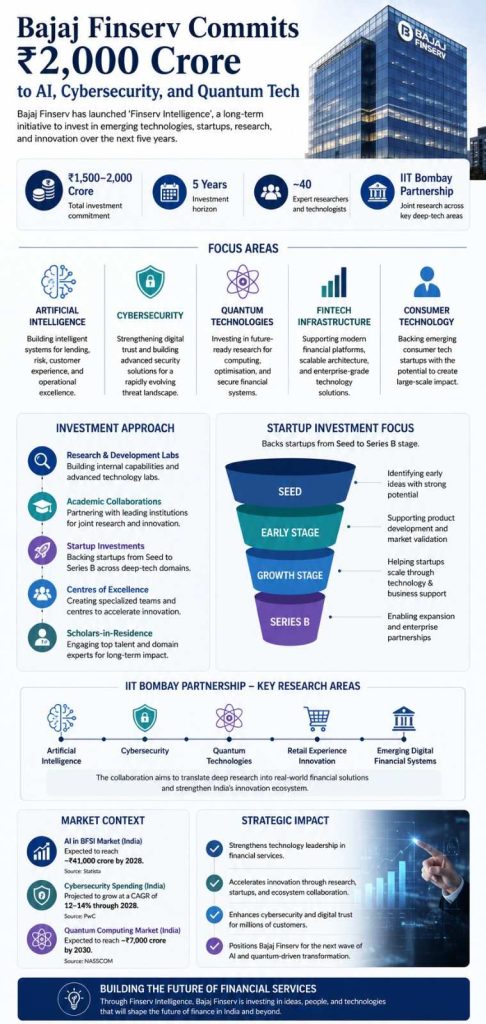
The Pune-headquartered financial services major has announced plans to invest between ₹1,500 crore and ₹2,000 crore over the next five years in artificial intelligence (AI), cybersecurity, quantum technologies, fintech infrastructure, and emerging consumer technology platforms through a new initiative called Finserv Intelligence. The programme combines startup investments, academic collaborations, in-house research, and long-term technology development.


At a time when Indian financial institutions are rapidly integrating AI into lending, customer service, fraud detection, and risk management, Bajaj Finserv’s move stands out because of its scale and its focus on foundational technologies rather than purely operational automation.
The initiative reflects a broader trend emerging across India’s financial sector: the belief that future competitive advantage will depend not only on distributing financial products but also on owning the technology platforms that power them.
A Strategic Shift Beyond Traditional Fintech
Under Finserv Intelligence, Bajaj Finserv plans to build a technology ecosystem that spans research institutions, startups, venture investments, and internal innovation teams. The company has indicated that investments will target startups from seed stage through Series B, particularly those working in AI, cybersecurity, quantum computing, fintech, and consumer technology.
The initiative is designed with a five-to-ten-year horizon rather than a near-term return cycle. According to company disclosures, the programme will include:
- Research and development laboratories
- Centres of excellence
- Startup investment programmes
- Academic collaborations
- Scholars-in-residence initiatives
- Dedicated in-house technology teams
The company is also building a specialist team of approximately 40 researchers and experts focused on emerging technologies.
This approach suggests Bajaj Finserv is positioning itself not merely as a consumer of technology but as a creator and investor in technologies that could shape future financial services infrastructure.
The IIT Bombay Partnership
One of the most significant components of the announcement is Bajaj Finserv’s partnership with Indian Institute of Technology Bombay.
The two organisations have signed agreements to establish a joint research centre focused on:
- Artificial intelligence
- Cybersecurity
- Quantum technologies
- Retail experience innovation
- Emerging digital financial systems
The collaboration is expected to bridge a longstanding gap in India’s innovation ecosystem: translating academic research into commercially deployable products.
While India produces world-class engineering talent, industry observers have frequently noted that commercialization of deep-tech research remains weaker than in ecosystems such as the United States, China, and parts of Europe. Partnerships between corporations and research institutions are increasingly viewed as necessary for scaling indigenous innovation.
For Bajaj Finserv, the IIT Bombay alliance could provide access to advanced research capabilities while helping accelerate the development of technologies tailored for Indian financial markets.
Why AI Has Become a Strategic Priority for Financial Institutions
The timing of the investment is notable.
Financial services companies worldwide are rapidly integrating AI into core operations. Applications now extend far beyond customer support chatbots.
Across banking, lending, insurance, and payments, AI is increasingly used for:
- Credit underwriting
- Fraud detection
- Customer acquisition
- Collections
- Risk modelling
- Claims processing
- Personalised financial recommendations
- Regulatory compliance monitoring
Bajaj Finserv and its lending arm have already demonstrated growing adoption of AI-led systems. Earlier reports indicated that AI-powered voice systems were being used to process millions of customer interactions and contribute to loan disbursals through automated workflows.
The company’s latest announcement suggests management sees AI not merely as an efficiency tool but as a foundational technology that could reshape product development and distribution across financial services.
As generative AI models become more capable, financial institutions are increasingly investing in proprietary systems to maintain control over customer data, compliance requirements, and decision-making processes.
Cybersecurity Is Becoming a Boardroom Issue
The inclusion of cybersecurity as a core investment pillar is equally significant.
As financial institutions digitise customer journeys and deploy AI systems at scale, cyber risks are growing more complex. AI-powered attacks, synthetic identities, automated phishing campaigns, and advanced fraud techniques are forcing organisations to rethink security infrastructure.
For companies handling millions of customer records and financial transactions, cybersecurity is no longer solely an IT function—it has become a strategic business priority.
Industry-wide spending on cybersecurity continues to rise as regulators, investors, and consumers demand stronger safeguards around data protection and operational resilience.
For Bajaj Finserv, investing in cybersecurity research alongside AI development reflects an understanding that the two technologies are increasingly intertwined.
The more AI is integrated into financial systems, the more security becomes a prerequisite rather than an afterthought.
Why Quantum Technology Is Part of the Strategy
Perhaps the most ambitious component of the initiative is its focus on quantum technologies.
Quantum computing remains an emerging field globally, with most commercial applications still in development. However, large financial institutions have begun exploring quantum capabilities because of their potential impact on:
- Portfolio optimisation
- Risk simulations
- Cryptography
- Fraud analytics
- Complex financial modelling
Although practical large-scale quantum deployment may still be years away, early investment allows organisations to develop expertise before the technology matures.
The inclusion of quantum research alongside AI and cybersecurity indicates Bajaj Finserv is looking beyond immediate business needs and positioning itself for future technological shifts.
This mirrors strategies adopted by several global financial institutions that are funding quantum research programmes despite uncertain commercial timelines.
The Broader Context: India’s Deep-Tech Moment
Bajaj Finserv’s announcement comes amid increasing momentum in India’s deep-tech ecosystem.
Government initiatives, rising venture capital interest, and growing corporate participation have pushed AI, semiconductor design, robotics, defence technology, cybersecurity, and quantum research into mainstream business discussions.
Yet challenges remain.
India’s private-sector R&D expenditure remains relatively low compared with major innovation economies. Industry leaders and policymakers have repeatedly highlighted the need for stronger collaboration between academia, startups, and corporations.
The Finserv Intelligence model appears designed specifically to address this gap by creating a platform where:
- Researchers can access commercial deployment opportunities.
- Startups can gain enterprise-scale distribution.
- Corporations can access emerging technologies earlier.
If executed effectively, such models could help accelerate commercialization of Indian research while creating new categories of technology companies.
What This Means for Startups
For founders, the announcement could represent more than another corporate venture programme.
Unlike many innovation initiatives that primarily provide capital, Bajaj Finserv is positioning Finserv Intelligence as an ecosystem that offers operational expertise, governance frameworks, regulatory understanding, distribution capabilities, and access to real-world financial services infrastructure.
For startups building AI infrastructure, cybersecurity products, or financial technologies, access to a large financial services organisation can often be more valuable than funding alone.
Enterprise adoption remains one of the biggest challenges facing Indian deep-tech startups. Partnerships with established institutions can significantly shorten commercialisation timelines.
The Competitive Landscape
Bajaj Finserv is not alone in increasing its AI investments.
Across India’s financial sector, banks, non-banking financial companies (NBFCs), insurers, and fintech firms are expanding investments in automation, analytics, and AI-powered customer experiences. Industry discussions increasingly focus on how AI can improve underwriting quality, reduce operating costs, and strengthen fraud prevention.
What differentiates Bajaj Finserv’s approach is the combination of:
- Long-term capital commitment
- Academic partnerships
- Startup investments
- In-house research capabilities
- Quantum technology exploration
This positions the initiative closer to a corporate innovation platform than a traditional venture fund.
Risks and Execution Challenges
Despite the strategic ambition, success is far from guaranteed.
Deep-tech investments typically involve:
- Long development cycles
- High failure rates
- Uncertain commercial outcomes
- Significant talent acquisition challenges
Quantum technologies, in particular, remain highly experimental from a commercial perspective.
Similarly, many corporate innovation programmes struggle to translate research into scalable business outcomes.
The effectiveness of Finserv Intelligence will ultimately depend on its ability to move beyond research and generate technologies that deliver measurable value for customers, partners, and shareholders.
Outlook
Bajaj Finserv’s ₹2,000 crore commitment reflects a growing recognition among Indian financial institutions that future growth will increasingly depend on technological capabilities rather than financial products alone.
The launch of Finserv Intelligence signals a broader shift within corporate India—from adopting technology developed elsewhere to participating in its creation.
Whether the initiative ultimately produces breakthrough innovations remains uncertain. However, the scale of investment, the partnership with IIT Bombay, and the focus on AI, cybersecurity, and quantum technologies suggest that Bajaj Finserv is preparing for a future in which financial services companies compete as much on technology platforms as they do on balance sheets.
For India’s deep-tech ecosystem, that could be one of the more important developments to watch over the coming decade.
Also Read : Venture Investments Halve in April to $2.7 Billion as Rupee Depreciation Weighs on Sentiment
Last Updated on Saturday, May 30, 2026 1:07 pm by Startup Newswire Team