


For nearly a decade, India’s SaaS boom was powered by one foundational advantage: abundant engineering talent. From Bengaluru to Chennai and Pune, startups scaled rapidly by hiring large developer teams capable of building products for global markets at comparatively lower costs.
That model is now changing.


Across India’s SaaS ecosystem, startups are becoming more cautious about engineering hiring — not because product development has slowed, but because artificial intelligence is fundamentally altering how software is built, tested, maintained, and shipped.
Founders are discovering that smaller teams equipped with AI coding copilots, automation infrastructure, and AI-native workflows can deliver output that previously required significantly larger engineering organizations. At the same time, venture capital markets remain disciplined after the post-pandemic correction, pushing startups toward profitability and efficiency rather than aggressive headcount expansion.
The result is a structural shift in startup hiring: fewer entry-level engineering roles, more demand for highly specialized AI talent, and a growing emphasis on productivity per employee instead of total employee count.
This transition is not unique to India. But because India became one of the world’s largest software talent hubs during the cloud and SaaS expansion era, the effects are particularly visible across the country’s startup ecosystem.
The SaaS Hiring Slowdown Is Real — But It’s More Nuanced Than Layoffs
India’s startup ecosystem is not experiencing a complete collapse in tech hiring. In fact, demand for AI engineers, cloud specialists, infrastructure experts, cybersecurity professionals, and product-focused developers remains strong.
What is changing is the nature of hiring.
Industry reports and staffing data increasingly show startups shifting away from volume-led recruitment toward targeted, high-skill hiring. Companies are reducing broad-based engineering expansion while prioritizing specialized talent that can work effectively in AI-assisted environments.
This shift is visible across both startups and larger technology organizations.
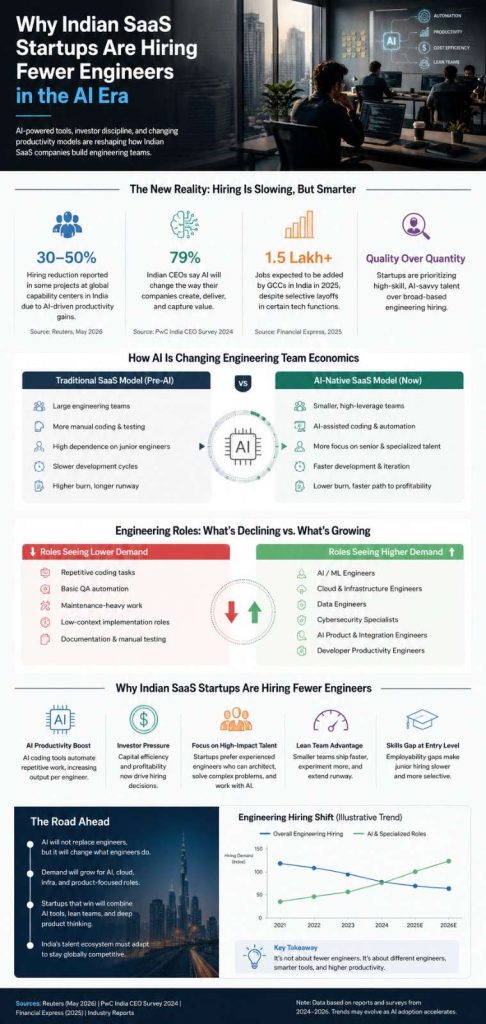
According to Reuters, executives at global capability centers in India have reported hiring reductions of 30% to 50% for some planned projects as AI reshapes delivery models and improves productivity.
Similarly, Reuters reported that companies are increasingly valuing domain expertise and business integration skills over routine coding capabilities, as AI tools automate more repetitive software development work.
The change is especially significant for SaaS startups because their business models are already highly automation-driven. AI amplifies that advantage further.
AI Coding Tools Have Changed Startup Economics
A major driver behind reduced engineering hiring is the rapid adoption of AI-assisted software development tools.
Platforms such as GitHub Copilot, Cursor, Claude, OpenAI Codex-style systems, and enterprise AI developer agents are accelerating coding productivity across the software industry. Tasks like boilerplate generation, debugging assistance, test creation, API integration, documentation, and code refactoring increasingly require fewer manual hours.
For startups, this changes unit economics dramatically.
A five-person engineering team using AI-assisted workflows can now achieve development velocity that once required teams two or three times larger. Founders say this allows companies to extend runway, reduce burn, and reach profitability faster without sacrificing shipping speed.
The shift is particularly attractive in a funding environment where investors increasingly reward operational discipline over “growth at all costs.”
Several SaaS founders and CTOs privately acknowledge that AI tools have reduced the urgency of hiring junior engineers for routine implementation work. Instead, companies prefer experienced developers who can architect systems, validate AI-generated code, manage infrastructure complexity, and integrate AI into core workflows.
This does not mean engineers are becoming irrelevant. It means the value hierarchy inside engineering teams is changing.
The Post-2021 Funding Correction Still Shapes Hiring
The AI shift is happening alongside another major force: venture capital discipline.
During 2020–2022, Indian SaaS startups aggressively expanded teams amid cheap capital, global digital acceleration, and intense competition for talent. Large engineering teams became signals of ambition and scale.
That environment no longer exists.
Since the global technology slowdown and correction in startup funding markets, investors have pushed founders to prioritize capital efficiency, sustainable growth, and profitability. Startups are under greater pressure to demonstrate revenue productivity per employee.
In practice, that means:
- slower hiring
- leaner teams
- automation-first operations
- reduced experimentation costs
- stronger scrutiny of engineering productivity
Many founders now view AI as a mechanism for maintaining product velocity while keeping organizational structures smaller.
Data from India’s startup ecosystem shows layoffs and selective hiring occurring simultaneously. Companies continue hiring in AI, cloud, and data roles while reducing less specialized or repetitive functions.
The hiring reset, therefore, is less about eliminating engineers entirely and more about redesigning how engineering organizations operate.
Why Junior Engineering Roles Are Under Pressure
The biggest disruption is occurring at the entry level.
Historically, Indian SaaS companies relied heavily on junior engineers for implementation-heavy work: frontend changes, testing, documentation, maintenance tasks, integration support, and internal tooling.
AI systems are increasingly capable of handling substantial portions of that workflow.
As a result, startups are becoming more selective about fresher hiring and junior developer expansion.
Executives quoted by Reuters noted that AI adoption is reducing demand for routine programming work while increasing expectations around adaptability, domain understanding, and AI literacy.
This creates a growing divide in the market:
Roles Losing Relative Demand
- repetitive coding tasks
- basic QA automation
- maintenance-heavy execution work
- low-context implementation roles
Roles Seeing Higher Demand
- AI infrastructure engineers
- machine learning engineers
- AI product specialists
- data platform engineers
- cybersecurity professionals
- developer productivity engineers
- AI integration architects
This explains why overall engineering hiring may appear slower even as compensation for elite AI talent rises sharply.
Indian SaaS Startups Are Moving Toward “High-Leverage Teams”
One of the most important shifts underway is philosophical rather than technical.
For years, startup scaling often meant increasing headcount aggressively. In the AI era, many SaaS founders are embracing the idea of “high-leverage teams” — smaller groups capable of generating disproportionately large output through automation and AI tooling.
This trend mirrors broader global technology patterns.
Salesforce CEO Marc Benioff recently stated that AI-driven productivity gains reduced the need for additional software engineering hiring.
Other global SaaS firms are reorganizing around AI-native operations, focusing on smaller teams with higher output expectations.
Indian SaaS founders are closely watching these models.
The implications are significant:
- startups may reach meaningful ARR milestones with fewer employees
- engineering productivity metrics become more important than team size
- hiring shifts toward seniority and specialization
- AI fluency becomes a core engineering expectation
In many ways, the AI era may reward engineering judgment more than raw coding volume.
Why AI Is Not Simply “Replacing Engineers”
Despite widespread anxiety around AI-driven job displacement, most industry observers do not believe software engineering itself is disappearing.
Instead, engineering work is evolving.
Academic research on AI-assisted software development argues that software engineering involves much more than generating code — including maintenance, reliability, architecture, governance, and systems thinking.
Even executives optimistic about AI productivity gains acknowledge the growing need for experienced engineers capable of overseeing complex AI-enabled systems.
Palo Alto Networks CEO Nikesh Arora recently argued that AI may ultimately increase demand for engineers by enabling companies to execute more ambitious projects.
This perspective is increasingly common among enterprise technology leaders: AI reduces low-level repetitive work, but expands opportunities for higher-order engineering and product development.
For India, this means the long-term question is not whether engineering jobs disappear, but whether the workforce can adapt quickly enough to the new skill requirements.
India’s Engineering Education System Faces a New Test
India produces one of the world’s largest pools of engineering graduates annually. But the AI transition is exposing a deeper issue: employability gaps.
Employers increasingly want engineers who can:
- work with AI tools effectively
- understand product and business context
- manage cloud-native infrastructure
- integrate APIs and AI systems
- think architecturally rather than execute repetitive tasks
That raises difficult questions for engineering colleges still focused heavily on theoretical instruction and legacy curricula.
Industry leaders are already calling for stronger collaboration between academia and technology companies to prepare graduates for AI-driven workplaces.
The risk is that India could produce large volumes of engineering graduates while demand increasingly concentrates around a smaller pool of AI-capable talent.
The SaaS Companies Likely to Win in the AI Era
The next generation of successful Indian SaaS startups may look very different from the previous one.
Instead of massive engineering organizations, future category leaders may operate with:
- smaller product teams
- AI-augmented engineering workflows
- globally distributed talent
- higher revenue per employee
- automation-heavy customer operations
- faster experimentation cycles
This could improve capital efficiency significantly for startups targeting global markets.
At the same time, it may intensify competition for elite technical talent, especially in:
- AI systems
- machine learning infrastructure
- applied AI product engineering
- AI security
- developer tooling
The hiring market is therefore becoming narrower but more premium.
The Future: Fewer Engineers, or Different Engineers?
The headline narrative — “AI is killing engineering jobs” — oversimplifies what is happening.
Indian SaaS startups are not necessarily building fewer products. In many cases, they are building faster than before.
What is changing is the ratio between output and headcount.
AI is allowing startups to operate leaner, automate repetitive work, and demand broader capabilities from engineers. The result is fewer generalized hiring sprees and more selective recruitment focused on experienced, high-leverage talent.
For India’s SaaS ecosystem, this transition could ultimately produce stronger, more globally competitive companies. But it also creates a significant workforce challenge: millions of engineers may need to adapt to a software industry where coding alone is no longer enough.
The winners in this new era are unlikely to be the companies with the largest engineering teams.
They may be the ones with the smartest workflows.
Also Read : Honasa Consumer Q4 Profit Surges to Rs 69.43 Crore; Declares Maiden Final Dividend
Last Updated on Saturday, May 23, 2026 3:28 pm by Startup Newswire Team