

India’s independent music economy is entering a new phase of institutional attention.
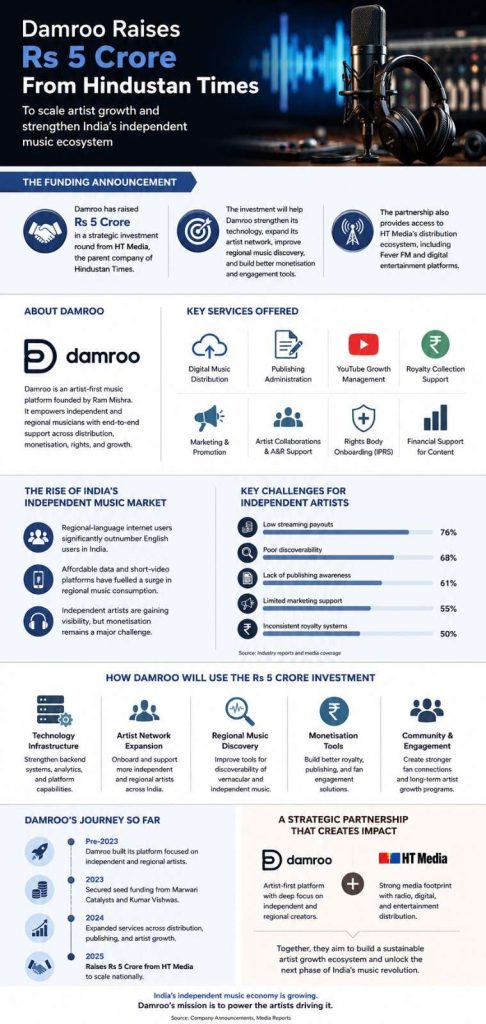
Mumbai-based music streaming and artist services platform Damroo has raised a strategic investment of Rs 5 crore from HT Media, the parent company of Hindustan Times, in a move that reflects growing confidence in India’s regional and creator-led music ecosystem.


The investment will be used to strengthen Damroo’s technology infrastructure, scale artist onboarding, improve regional music discovery, and build monetisation and audience engagement tools for creators across India. The partnership will also provide Damroo access to HT Media’s broader distribution ecosystem, including Fever FM and digital entertainment properties.
The development comes at a time when India’s music industry is witnessing a sharp shift away from a Bollywood-dominated listening culture toward regional, independent, and vernacular content.
A Strategic Bet on India’s Regional Creator Economy
Founded by Ram Mishra, Damroo positions itself as an artist-first platform focused on independent and regional musicians. Unlike traditional streaming platforms that primarily optimise for listener consumption, Damroo is building infrastructure around artist growth, rights management, publishing access, and revenue generation.
The company currently offers services including:
- Digital music distribution
- Publishing administration
- YouTube growth management
- Royalty collection support
- Marketing and promotional support
- Artist collaborations and A&R guidance
- Financial support for content production
Damroo also assists creators in joining rights bodies such as the Indian Performing Right Society (IPRS), allowing artists to access publishing royalties and long-term recurring income streams.
The latest funding round is not merely a capital infusion. It represents a broader convergence between legacy media companies and India’s fast-growing creator economy.
For HT Media, the investment expands its exposure to regional entertainment and digital creator ecosystems. For Damroo, the partnership offers a rare combination of capital, distribution, and mainstream media amplification.
Why Independent Music Is Becoming a Serious Business Opportunity
India’s music consumption patterns have changed dramatically over the past five years.
Short-video platforms, regional content apps, vernacular internet adoption, and affordable mobile data have collectively enabled independent artists to bypass traditional gatekeepers.
However, while discovery has improved, monetisation remains fragmented.
Many artists still struggle with:
- Inconsistent royalty systems
- Low streaming payouts
- Weak discoverability outside algorithms
- Limited marketing infrastructure
- Lack of publishing awareness
- Absence of long-term career support
This is the gap startups like Damroo are trying to address.
According to industry estimates referenced in earlier reporting by The Economic Times, regional music already accounts for a substantial share of India’s music consumption market. Earlier coverage of Damroo’s seed round in 2023 also highlighted the company’s focus on underserved vernacular audiences and independent creators.
The trend aligns with broader consumption shifts across India’s digital economy, where regional-language internet users now significantly outnumber English-language users.
The Media Distribution Advantage
One of the most notable aspects of the deal is the strategic role of HT Media.
Unlike traditional venture investments that are purely financial, this partnership includes media ecosystem support through platforms such as Fever FM and HT’s entertainment network.
That matters because independent artists often face a distribution bottleneck rather than a talent bottleneck.
Large streaming platforms are crowded and algorithm-driven. Breaking through requires visibility, repeat exposure, and audience trust — areas where legacy media companies still hold significant influence.
By combining artist infrastructure with radio, digital publishing, and entertainment media reach, Damroo could potentially create a more integrated artist growth engine than standalone distribution platforms.
This model resembles a broader industry shift where media companies increasingly act as ecosystem enablers rather than only content publishers.
India’s Music Startup Ecosystem Is Evolving
India’s independent music ecosystem has historically lacked the institutional support systems available in mature global music markets.
In countries like the United States and South Korea, artist ecosystems are supported by agencies, publishing houses, creator networks, performance infrastructure, merchandising ecosystems, and fan community platforms.
India’s independent artists, by contrast, have often relied on fragmented tools spread across streaming apps, YouTube, social media, and third-party distributors.
That fragmentation has created opportunities for startups focused on creator enablement.
Damroo is part of a newer wave of music-tech startups attempting to build vertically integrated support systems around artists rather than only audiences.
The company’s earlier seed round in 2023 included participation from startup accelerator Marwari Catalysts and noted public intellectual Kumar Vishwas.
Since then, the platform appears to have expanded its positioning beyond streaming into a broader artist services and monetisation platform.
Challenges Ahead
Despite growing momentum, the path ahead for music-tech startups in India remains complex.
The sector faces several structural challenges:
1. Monetisation Economics
Streaming revenues in India remain significantly lower than mature Western markets on a per-user basis.
Even as consumption rises, creator earnings often remain modest unless supplemented through live events, sponsorships, fan communities, or direct monetisation tools.
2. Platform Competition
Damroo operates in an intensely competitive ecosystem dominated by large streaming companies with deep capital reserves and extensive catalogues.
Differentiation through artist support and regional discovery will likely be critical.
3. Rights Management Awareness
A large number of emerging artists still lack awareness around publishing rights, licensing structures, and royalty systems.
Education and onboarding may become as important as technology infrastructure.
4. Discovery Saturation
India’s creator economy has become increasingly crowded. Building sustainable discovery systems beyond algorithmic virality will be a major challenge for every music-tech platform.
Why Investors Are Paying Attention to Creator Infrastructure
The funding also reflects a broader investor thesis emerging across India’s digital economy: creator infrastructure may become more valuable than creator consumption alone.
While entertainment platforms compete for audience attention, infrastructure companies help creators monetise, distribute, and scale their careers.
Globally, investors have increasingly backed platforms focused on:
- Creator monetisation
- Rights management
- Fan engagement
- Community commerce
- Distribution infrastructure
- Independent publishing tools
India’s independent music market remains relatively underpenetrated in these areas, creating room for specialised platforms.
Damroo’s positioning around regional creators may also prove strategically significant, especially as non-metro consumption continues to dominate digital growth trends.
Future Outlook
The next phase for Damroo will likely depend on execution across three areas:
- Building scalable artist monetisation systems
- Improving discovery for regional and independent music
- Leveraging HT Media’s distribution capabilities effectively
If the company succeeds, it could strengthen its position as a creator-first infrastructure layer within India’s evolving music economy.
More importantly, the funding signals a growing recognition that India’s independent music ecosystem is no longer a niche cultural segment — it is becoming a serious digital business category.
Also Read : Oister Global Launches ₹500 Crore Secondary-Focused Startup Fund
Last Updated on Thursday, May 21, 2026 9:33 am by Startup Newswire Team