


• About us
  • Advertise with us
  • Contact us
  • Get Featured
Newsletter
Startup Newswire
Advertisement
  • Home
  • Startup News
  • Funding News
  • Latest News
  • Interviews
  • Startup Stories
  • Brand Post
No Result
View All Result
  • Home
  • Startup News
  • Funding News
  • Latest News
  • Interviews
  • Startup Stories
  • Brand Post
No Result
View All Result
Startup Newswire
No Result
View All Result
Home News Startup News

Explained: How the Digital Competition Bill Will Redefine Platform Neutrality for Indian Startups

Startup Newswire Team by Startup Newswire Team
Thursday, February 5, 2026 4:34 am
in Startup News, Trending
0
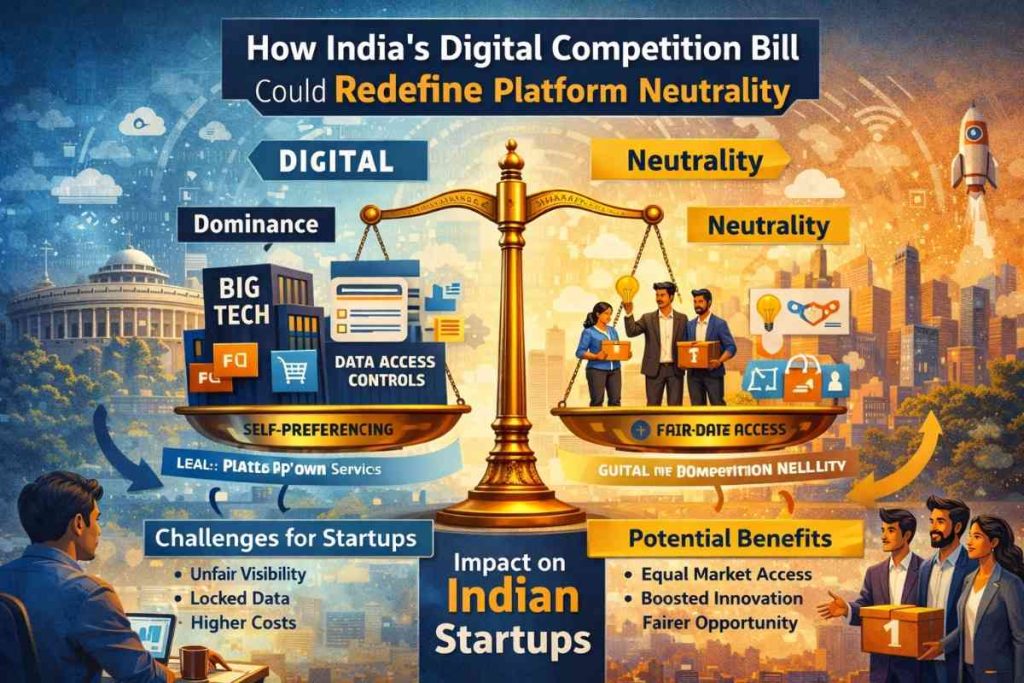
Illustration showing Indian startups competing on digital platforms under the proposed Digital Competition Bill framework.

India’s proposed Digital Competition Bill aims to reshape platform neutrality by limiting the market power of dominant digital platforms and creating fairer conditions for startups.

189
SHARES
1.5k
VIEWS
Share on Facebook
Share on Twitter

As India’s digital economy matures, the rules governing competition in online markets are undergoing a fundamental re-examination. At the centre of this shift is the proposed Digital Competition Bill, a legislative effort aimed at addressing the growing market power of large digital platforms and redefining the idea of platform neutrality for startups operating within their ecosystems.

India’s current competition framework, anchored in the Competition Act of 2002, was designed for a pre-platform era. While it has been used to investigate anti-competitive conduct in digital markets, enforcement has largely been ex-post, meaning regulatory action typically follows after harm has already occurred. Policymakers and regulators have increasingly acknowledged that this approach may be inadequate in fast-moving digital markets where network effects, data advantages, and scale can entrench dominance quickly and irreversibly.


Related articles

Groq Targets $650 Million Fundraise After Nvidia Partnership as AI Inference Race Intensifies

Groq Targets $650 Million Fundraise After Nvidia Partnership as AI Inference Race Intensifies

Saturday, May 30, 2026 3:45 pm
Bajaj Finserv Commits ₹2,000 Crore to AI, Cybersecurity, and Quantum Tech

Bajaj Finserv Commits ₹2,000 Crore to AI, Cybersecurity, and Quantum Tech

Saturday, May 30, 2026 1:07 pm

The Digital Competition Bill was proposed as a response to this gap. Drawing on global regulatory developments, particularly in the European Union, the Bill sought to introduce an ex-ante framework that would allow regulators to impose obligations on certain large digital enterprises before anti-competitive behaviour distorts markets. While the Bill is currently under review and has not yet been enacted, its underlying principles continue to shape policy debate, especially around the concept of platform neutrality.

Platform neutrality refers to the expectation that digital intermediaries act as fair and impartial gateways rather than competitors that privilege their own services. In India’s startup ecosystem, this issue has become increasingly significant as young companies rely heavily on dominant platforms for distribution, visibility, payments, advertising, and cloud infrastructure. App stores, online marketplaces, search engines, and social media platforms now function as essential digital infrastructure, making access to them critical for startup survival and growth.

The proposed framework behind the Digital Competition Bill attempted to address this imbalance by identifying certain large platforms as systemically significant digital enterprises based on factors such as scale, user base, and market influence. These platforms would be subject to specific behavioural obligations designed to preserve competitive neutrality. The intent was to prevent practices such as self-preferencing, where a platform promotes its own products or services more prominently than those of third-party businesses operating on the same platform.

For Indian startups, the implications of such rules are substantial. Many early-stage companies compete directly with services launched by the very platforms they depend on. When a platform controls rankings, recommendations, default settings, or access to user data, even small algorithmic advantages can determine market winners. Startup founders have long argued that without neutrality safeguards, innovation risks being crowded out not by better products but by structural disadvantages.

Another critical concern addressed in the policy discussions around the Bill is data access. Dominant platforms accumulate vast amounts of user and transactional data, which can be used to refine products, train algorithms, and enter adjacent markets. Startups, by contrast, often lack comparable access, making it difficult to compete in data-intensive sectors such as artificial intelligence, digital advertising, and personalized commerce. The Digital Competition Bill sought to curb unfair use of non-public business data by platforms, a move that many startup advocates view as essential for maintaining competitive balance.
However, the Bill has also faced significant scrutiny. Industry bodies and technology companies raised concerns about rigid regulatory thresholds and the possibility of over-regulation. Critics warned that an inflexible ex-ante regime could unintentionally penalize fast-growing Indian companies as they scale, potentially discouraging investment and innovation. There were also questions about regulatory overlap, given the simultaneous evolution of India’s data protection framework and existing competition law.

These concerns led to closer parliamentary examination of the draft Bill. A parliamentary committee reviewing the proposal recommended that the legislation be reconsidered and refined, citing the need for greater clarity, proportionality, and alignment with India’s economic priorities. Following this review, the government indicated that it would undertake a broader market study to reassess digital competition dynamics before moving forward with a revised framework.

This pause has not diminished the relevance of the underlying issues. Instead, it reflects a recognition that regulating digital markets requires careful calibration. The challenge for policymakers lies in striking a balance between preventing market abuse by entrenched platforms and preserving the flexibility that allows innovation-driven businesses to grow.

For startups, the outcome of this process will shape the competitive environment for years to come. A well-designed digital competition regime could reduce entry barriers, improve visibility for new products, and encourage innovation by ensuring that success depends on merit rather than platform control. Conversely, poorly targeted regulation risks adding compliance burdens without addressing the structural asymmetries that startups face.

As India continues to position itself as a global digital and startup hub, the debate around platform neutrality is no longer theoretical. It touches on fundamental questions about market access, fairness, and the role of regulation in a technology-driven economy. The eventual shape of the Digital Competition Bill, whether through a revised version or alternative regulatory instruments, will signal how India intends to balance the power of large platforms with the aspirations of its startup ecosystem.

The coming months are likely to see renewed consultations, market studies, and policy deliberations. While the legislative path remains uncertain, the direction of travel is clear: platform neutrality has become a central pillar of India’s digital competition discourse, and its resolution will play a defining role in the future of Indian startups.

Also Read : Why Cross-Border M&A Is Becoming the Preferred Exit Strategy for Indian Deeptech Founders

Add startupnewswire.in as preferred source on google – Click here

Last Updated on Thursday, February 5, 2026 4:34 am by Startup Newswire Team

Share76
Tweet47

Related Posts

Groq Targets $650 Million Fundraise After Nvidia Partnership as AI Inference Race Intensifies

Groq Targets $650 Million Fundraise After Nvidia Partnership as AI Inference Race Intensifies

by Startup Newswire Team
Saturday, May 30, 2026 3:45 pm
0

The artificial intelligence infrastructure market is entering a new phase—one where inference, rather than model training, is increasingly becoming the...

Bajaj Finserv Commits ₹2,000 Crore to AI, Cybersecurity, and Quantum Tech

Bajaj Finserv Commits ₹2,000 Crore to AI, Cybersecurity, and Quantum Tech

by Startup Newswire Team
Saturday, May 30, 2026 1:07 pm
0

India’s financial services industry is entering a new phase of technological competition, and few companies are signalling that shift as...

Venture Investments Halve in April to $2.7 Billion as Rupee Depreciation Weighs on Sentiment

Venture Investments Halve in April to $2.7 Billion as Rupee Depreciation Weighs on Sentiment

by Startup Newswire Team
Tuesday, May 26, 2026 6:12 am
0

India’s private equity and venture capital ecosystem entered a noticeably slower phase in April, with investment activity falling sharply amid...

Honasa Consumer Q4 Profit Surges to Rs 69.43 Crore; Declares Maiden Final Dividend

Honasa Consumer Q4 Profit Surges to Rs 69.43 Crore; Declares Maiden Final Dividend

by Startup Newswire Team
Friday, May 22, 2026 1:10 pm
0

India’s digital-first beauty and personal care sector is entering a more mature phase, and Honasa Consumer appears determined to signal...

Damroo Raises Rs 5 Crore Investment to Scale Artist Growth Across India

Damroo Raises Rs 5 Crore Investment to Scale Artist Growth Across India

by Startup Newswire Team
Thursday, May 21, 2026 9:33 am
0

India’s independent music economy is entering a new phase of institutional attention. Mumbai-based music streaming and artist services platform Damroo...

Load More
  • Trending
  • Comments
  • Latest

Top 10 Aluminum Companies in India

Monday, July 15, 2024 7:42 pm

Top 10 Retail Pharmacy Chains in India

Saturday, July 13, 2024 5:38 pm

Top 10 Fintech Startups in India

Wednesday, June 12, 2024 1:49 pm

Ultrahuman Targets Rs 1,100 Cr Revenue Surge by FY26, Aims for Global Dominance

Thursday, October 9, 2025 8:00 am

Hello world!

1

Source.One: Transforming B2B Dynamics with Technology

0

Insights from Shark Tank’s Wealthiest Investor: Amit Jain on Entrepreneurship and Investment

0

CITTA: A Natural Baby Care Brand Founded by a Mother-Daughter Duo

0
PlayBlue Raises $2.7 Million in Seed Funding to Expand Retail and Digital Presence

PlayBlue Raises $2.7 Million in Seed Funding to Expand Retail and Digital Presence

Saturday, July 4, 2026 7:06 am
Preventive Wellness Startup Heatronics Raises ₹1.8 Crore in Seed Round Led by Inflection Point Ventures

Preventive Wellness Startup Heatronics Raises ₹1.8 Crore in Seed Round Led by Inflection Point Ventures

Thursday, July 2, 2026 10:50 am
Groq Targets $650 Million Fundraise After Nvidia Partnership as AI Inference Race Intensifies

Groq Targets $650 Million Fundraise After Nvidia Partnership as AI Inference Race Intensifies

Saturday, May 30, 2026 3:45 pm
Bajaj Finserv Commits ₹2,000 Crore to AI, Cybersecurity, and Quantum Tech

Bajaj Finserv Commits ₹2,000 Crore to AI, Cybersecurity, and Quantum Tech

Saturday, May 30, 2026 1:07 pm
startup news wire logo

Startup Newswire is a leading digital publication dedicated to covering the latest developments from India’s startup and innovation ecosystem. We deliver timely news on startup funding, product launches, acquisitions, founder stories, venture capital, emerging technologies, and business trends.

Our mission is to provide entrepreneurs, investors, business leaders, and professionals with accurate, credible, and insightful coverage that keeps them informed about the rapidly evolving startup landscape. Through independent journalism and expert analysis, we highlight the companies, founders, and ideas shaping the future of business.

Startup Newswire is a digital media initiative of Qi Media Network and is owned and operated by QITA IT Services Private Limited, headquartered in Hyderabad, India. Since 2023, we have been committed to delivering trusted business journalism while helping startups gain visibility and connect with the wider entrepreneurial ecosystem.

Categories
  • Brand Post
  • Events
  • Funding News
  • Interviews
  • Latest News
  • News
  • Opinion
  • Startup News
  • Startup Stories
  • Trending
Tags
Ahmedabad Ather Energy Azure Power Bangalore Bengaluru Bharat Heavy Electricals Limited (BHEL) BigBasket Capgemini India Chennai Cure.fit Delhi Ghaziabad Gurgaon Gurugram HCL Technologies Hindustan Unilever Limited (HUL) Hyderabad India Indian startups Infosys Kolkata Lenskart Mindtree Mumbai Narayana Health Nestlé India Netmeds New Delhi Noida Paris Paytm PhonePe Pune Rapido ReNew Power Samsung Simplilearn Swiggy Tata Consultancy Services (TCS) Tech Mahindra TrashCon UpGrad Wipro Zomato ZunRoof
Newsletter
[mc4wp_form]
  •  Partner With Us
  • About us
  • Advertise with us
  • Advertising & Sponsored Content Policy
  • AI & Automation Disclosure
  • Archive
  • Authors
  • Brand Post Disclaimer
  • Comment Policy
  • Contact us
  • Content Submission Guidelines
  • Contributor
  • Cookie Policy
  • Copyright Policy
  • Corrections and updates
  • Disclaimer Policy
  • DMCA Policy
  • Editorial Policy
  • Editorial Team
  • Ethics Policy
  • Fact-checking Policy
  • Get Featured
  • Grievance Redressal
  • Join Startup Newswire Community
  • Ownership and funding info
  • Privacy Policy
  • Refund Policy
  • RSS FEED
  • Submit Press Release
  • Submit Your Story
  • Terms and Conditions

© JNews Crafted with love by – Jegtheme.

No Result
View All Result
  • Contact Us
  • Homepages

© 2026 Startup Newswire. All Rights Reserved. Startup Newswire is a digital publication owned and operated by QITA IT Services Private Limited.