
• About us
  • Advertise with us
  • Contact us
  • Get Featured
Newsletter
Startup Newswire
Advertisement
  • Home
  • Startup News
  • Funding News
  • Latest News
  • Interviews
  • Startup Stories
  • Brand Post
No Result
View All Result
  • Home
  • Startup News
  • Funding News
  • Latest News
  • Interviews
  • Startup Stories
  • Brand Post
No Result
View All Result
Startup Newswire
No Result
View All Result
Home News Startup News

Explained: The Impact of SEZ Policy Reforms on India’s Manufacturing and Export Startups

Startup Newswire Team by Startup Newswire Team
Tuesday, January 27, 2026 5:19 am
in Startup News, Trending
0
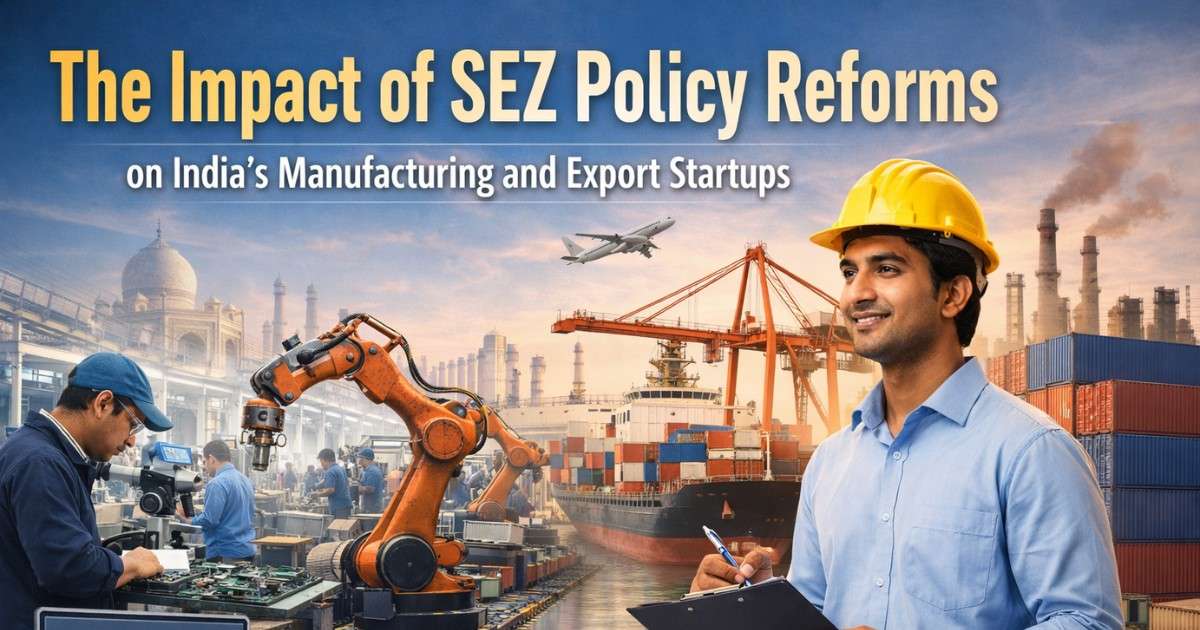
Illustration showing manufacturing factories inside an Indian Special Economic Zone with cargo containers, ships, aircraft and startup professionals, symbolising export growth and industrial reform.

SEZ policy reforms aim to boost India’s manufacturing ecosystem by giving export startups greater flexibility and market access.

189
SHARES
1.5k
VIEWS
Share on Facebook
Share on Twitter

India’s Special Economic Zones, once projected as the engines of export-led growth, are undergoing a significant policy reset. After years of underperformance, regulatory rigidity and fading investor interest, the government’s recent reforms to the SEZ framework are being positioned as a turning point for manufacturing and export-oriented startups. The changes come at a critical moment, as India attempts to reposition itself in global supply chains amid geopolitical shifts, slowing global trade, and intensifying competition from other Asian manufacturing hubs.

SEZs were originally conceived as duty-free enclaves with simplified regulations to attract foreign investment and boost exports. For a time, they delivered results, particularly in IT services and select manufacturing segments. Over the past decade, however, their relevance began to erode. Export growth from SEZs plateaued, several zones remained underutilised, and the withdrawal of key tax incentives reduced their attractiveness. At the same time, strict export obligations and limited access to the domestic market constrained operational flexibility, particularly for smaller firms and startups that lacked the financial resilience to absorb global demand shocks.


Related articles

Groq Targets $650 Million Fundraise After Nvidia Partnership as AI Inference Race Intensifies

Groq Targets $650 Million Fundraise After Nvidia Partnership as AI Inference Race Intensifies

Saturday, May 30, 2026 3:45 pm
Bajaj Finserv Commits ₹2,000 Crore to AI, Cybersecurity, and Quantum Tech

Bajaj Finserv Commits ₹2,000 Crore to AI, Cybersecurity, and Quantum Tech

Saturday, May 30, 2026 1:07 pm

The latest round of reforms seeks to address these structural flaws. By amending the SEZ Rules, the government has attempted to align the framework with contemporary manufacturing realities rather than the export-only logic of the early 2000s. Central to this shift is greater flexibility—both in terms of scale and market access—which could fundamentally alter how startups engage with SEZs.

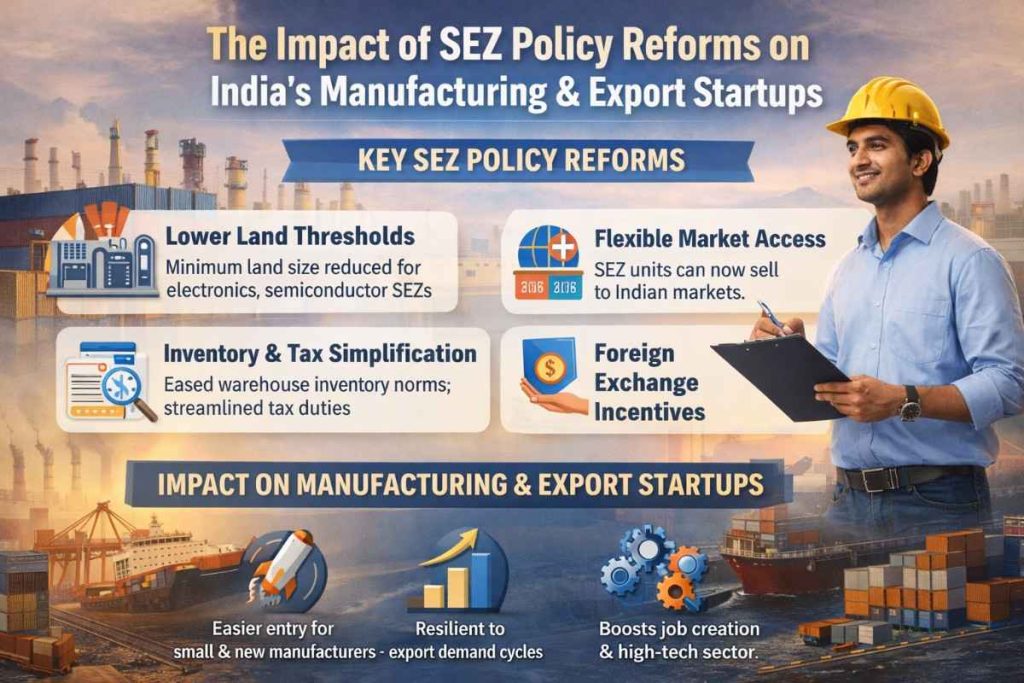
One of the most consequential changes is the relaxation of land requirements, especially for high-technology sectors such as electronics and semiconductors. Earlier norms favoured large corporations with access to vast land parcels, effectively excluding smaller players and startups. Reduced land thresholds now make it feasible for emerging manufacturers to establish operations within SEZs without prohibitive upfront costs. For startups operating in capital-intensive sectors, this lowers entry barriers and shortens the time between concept and production.

Equally important is the expanded access to the domestic market. Historically, SEZ units were largely locked into export-only models, with domestic sales subject to restrictive conditions. Under the revised framework, companies are permitted to sell in the domestic market after meeting applicable duties and compliance norms. This change offers startups a vital safety valve. In an era of volatile global demand, the ability to pivot between export and domestic sales can determine whether a young manufacturing venture survives a downturn or collapses under fixed costs.

For export startups, the reforms also ease compliance burdens. Changes to how net foreign exchange earnings are calculated and how inventories are managed reduce procedural friction that disproportionately affected smaller firms. These measures may appear technical, but for startups with limited legal and administrative capacity, simplified compliance can translate directly into cost savings and operational efficiency.

The reforms are also closely tied to India’s broader industrial strategy. As the government pushes initiatives such as domestic electronics manufacturing and semiconductor self-reliance, SEZs are being repositioned as specialised manufacturing hubs rather than generic export zones. This shift has implications beyond large investments. Startups involved in component manufacturing, design services, tooling, logistics and industrial software stand to benefit from clustering effects as anchor projects attract ancillary industries.

Employment and skill development are likely to follow. Manufacturing startups in SEZs tend to generate higher-skilled jobs compared to traditional assembly-based units. Over time, this could contribute to regional industrial ecosystems, particularly in states actively aligning their policies with the reformed SEZ framework.
However, the reforms are not without challenges. Infrastructure gaps, especially in power supply, logistics connectivity and port efficiency, remain critical constraints. Policy clarity on taxation and long-term incentives is still evolving, and frequent regulatory changes in the past have made investors cautious. Moreover, India continues to compete with countries that offer deeply integrated manufacturing ecosystems and aggressive investment incentives.

Despite these concerns, the direction of policy marks a clear departure from the rigid SEZ model of the past. By prioritising flexibility, startup participation and domestic market integration, the government has acknowledged that export competitiveness cannot be built on isolation alone. For manufacturing and export startups, the reformed SEZ regime offers not just fiscal or regulatory relief, but a more realistic pathway to scale in an uncertain global economy.

If implemented consistently and supported by infrastructure and administrative reform, these changes could help transform SEZs from underperforming enclaves into dynamic platforms for India’s next phase of manufacturing growth. In that transformation, startups may no longer be peripheral players, but central drivers of innovation, exports and industrial resilience.

Also Read : https://startupupdates.in/msme-growth-strategy-a-guide-to-navigating-the-updated-cgtmse-and-pmegp-schemes-in-2026/

Add startupnewswire.in as a preferred source on google – Click Here

Last Updated on Tuesday, January 27, 2026 5:19 am by Startup Newswire Team

Share76
Tweet47

Related Posts

Groq Targets $650 Million Fundraise After Nvidia Partnership as AI Inference Race Intensifies

Groq Targets $650 Million Fundraise After Nvidia Partnership as AI Inference Race Intensifies

by Startup Newswire Team
Saturday, May 30, 2026 3:45 pm
0

The artificial intelligence infrastructure market is entering a new phase—one where inference, rather than model training, is increasingly becoming the...

Bajaj Finserv Commits ₹2,000 Crore to AI, Cybersecurity, and Quantum Tech

Bajaj Finserv Commits ₹2,000 Crore to AI, Cybersecurity, and Quantum Tech

by Startup Newswire Team
Saturday, May 30, 2026 1:07 pm
0

India’s financial services industry is entering a new phase of technological competition, and few companies are signalling that shift as...

Venture Investments Halve in April to $2.7 Billion as Rupee Depreciation Weighs on Sentiment

Venture Investments Halve in April to $2.7 Billion as Rupee Depreciation Weighs on Sentiment

by Startup Newswire Team
Tuesday, May 26, 2026 6:12 am
0

India’s private equity and venture capital ecosystem entered a noticeably slower phase in April, with investment activity falling sharply amid...

Honasa Consumer Q4 Profit Surges to Rs 69.43 Crore; Declares Maiden Final Dividend

Honasa Consumer Q4 Profit Surges to Rs 69.43 Crore; Declares Maiden Final Dividend

by Startup Newswire Team
Friday, May 22, 2026 1:10 pm
0

India’s digital-first beauty and personal care sector is entering a more mature phase, and Honasa Consumer appears determined to signal...

Damroo Raises Rs 5 Crore Investment to Scale Artist Growth Across India

Damroo Raises Rs 5 Crore Investment to Scale Artist Growth Across India

by Startup Newswire Team
Thursday, May 21, 2026 9:33 am
0

India’s independent music economy is entering a new phase of institutional attention. Mumbai-based music streaming and artist services platform Damroo...

Load More
  • Trending
  • Comments
  • Latest

Top 10 Retail Pharmacy Chains in India

Saturday, July 13, 2024 5:38 pm

Top 10 Aluminum Companies in India

Monday, July 15, 2024 7:42 pm

Top 10 Fintech Startups in India

Wednesday, June 12, 2024 1:49 pm

CITTA: A Natural Baby Care Brand Founded by a Mother-Daughter Duo

Tuesday, February 27, 2024 7:18 am

Hello world!

1

Source.One: Transforming B2B Dynamics with Technology

0

Insights from Shark Tank’s Wealthiest Investor: Amit Jain on Entrepreneurship and Investment

0

CITTA: A Natural Baby Care Brand Founded by a Mother-Daughter Duo

0
PlayBlue Raises $2.7 Million in Seed Funding to Expand Retail and Digital Presence

PlayBlue Raises $2.7 Million in Seed Funding to Expand Retail and Digital Presence

Saturday, July 4, 2026 7:06 am
Preventive Wellness Startup Heatronics Raises ₹1.8 Crore in Seed Round Led by Inflection Point Ventures

Preventive Wellness Startup Heatronics Raises ₹1.8 Crore in Seed Round Led by Inflection Point Ventures

Thursday, July 2, 2026 10:50 am
Groq Targets $650 Million Fundraise After Nvidia Partnership as AI Inference Race Intensifies

Groq Targets $650 Million Fundraise After Nvidia Partnership as AI Inference Race Intensifies

Saturday, May 30, 2026 3:45 pm
Bajaj Finserv Commits ₹2,000 Crore to AI, Cybersecurity, and Quantum Tech

Bajaj Finserv Commits ₹2,000 Crore to AI, Cybersecurity, and Quantum Tech

Saturday, May 30, 2026 1:07 pm
startup news wire logo

Startup Newswire is a leading digital publication dedicated to covering the latest developments from India’s startup and innovation ecosystem. We deliver timely news on startup funding, product launches, acquisitions, founder stories, venture capital, emerging technologies, and business trends.

Our mission is to provide entrepreneurs, investors, business leaders, and professionals with accurate, credible, and insightful coverage that keeps them informed about the rapidly evolving startup landscape. Through independent journalism and expert analysis, we highlight the companies, founders, and ideas shaping the future of business.

Startup Newswire is a digital media initiative of Qi Media Network and is owned and operated by QITA IT Services Private Limited, headquartered in Hyderabad, India. Since 2023, we have been committed to delivering trusted business journalism while helping startups gain visibility and connect with the wider entrepreneurial ecosystem.

Categories
  • Brand Post
  • Events
  • Funding News
  • Interviews
  • Latest News
  • News
  • Opinion
  • Startup News
  • Startup Stories
  • Trending
Tags
Ahmedabad Ather Energy Azure Power Bangalore Bengaluru Bharat Heavy Electricals Limited (BHEL) BigBasket Capgemini India Chennai Cure.fit Delhi Ghaziabad Gurgaon Gurugram HCL Technologies Hindustan Unilever Limited (HUL) Hyderabad India Indian startups Infosys Kolkata Lenskart Mindtree Mumbai Narayana Health Nestlé India Netmeds New Delhi Noida Paris Paytm PhonePe Pune Rapido ReNew Power Samsung Simplilearn Swiggy Tata Consultancy Services (TCS) Tech Mahindra TrashCon UpGrad Wipro Zomato ZunRoof
Newsletter
[mc4wp_form]
  •  Partner With Us
  • About us
  • Advertise with us
  • Advertising & Sponsored Content Policy
  • AI & Automation Disclosure
  • Archive
  • Authors
  • Brand Post Disclaimer
  • Comment Policy
  • Contact us
  • Content Submission Guidelines
  • Contributor
  • Cookie Policy
  • Copyright Policy
  • Corrections and updates
  • Disclaimer Policy
  • DMCA Policy
  • Editorial Policy
  • Editorial Team
  • Ethics Policy
  • Fact-checking Policy
  • Get Featured
  • Grievance Redressal
  • Join Startup Newswire Community
  • Ownership and funding info
  • Privacy Policy
  • Refund Policy
  • RSS FEED
  • Submit Press Release
  • Submit Your Story
  • Terms and Conditions

© JNews Crafted with love by – Jegtheme.

No Result
View All Result
  • Contact Us
  • Homepages

© 2026 Startup Newswire. All Rights Reserved. Startup Newswire is a digital publication owned and operated by QITA IT Services Private Limited.