


India’s private equity and venture capital ecosystem entered a noticeably slower phase in April, with investment activity falling sharply amid a weakening rupee, elevated oil prices, and rising geopolitical uncertainty.
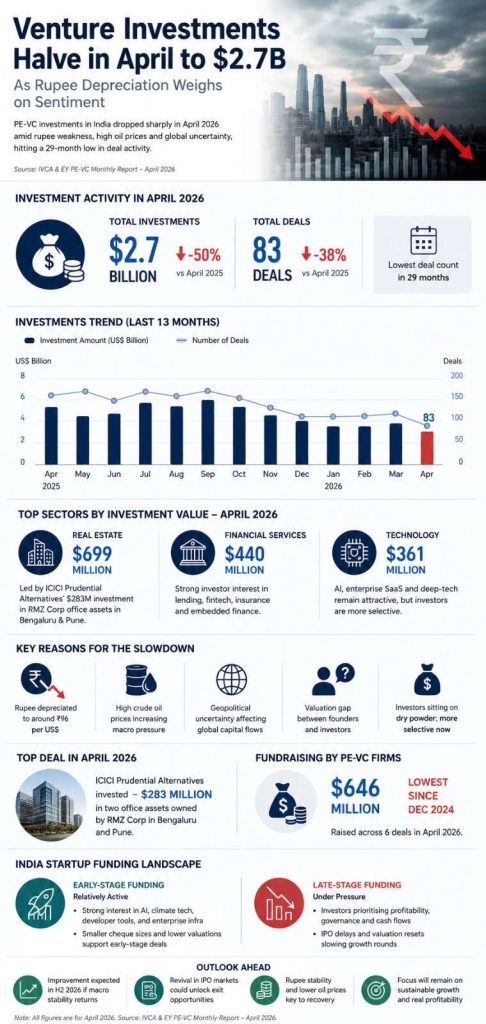
According to a joint report by the Indian Venture and Alternate Capital Association (IVCA) and EY, PE and VC investments in India dropped to $2.7 billion in April 2026 across 83 transactions — nearly half the value recorded both a year earlier and in March 2026. The slowdown marks one of the weakest monthly performances for India’s private capital markets in more than two years.


The decline comes at a time when the Indian startup ecosystem had begun showing signs of stabilisation after a difficult funding cycle between 2022 and 2024. Instead, April’s numbers suggest that global macroeconomic pressures are once again reshaping investor behaviour.
A Sharp Pullback in Capital Deployment
The April investment tally reflects a broader cooling in dealmaking sentiment.
The number of transactions dropped to 83, compared with 134 deals in April last year and 131 deals in March 2026, making it the lowest monthly deal count in 29 months.
Market participants attribute the slowdown to three overlapping pressures:
- depreciation of the Indian rupee
- high crude oil prices
- geopolitical instability affecting global capital flows
The rupee recently weakened to around ₹96 against the US dollar, intensifying concerns among foreign institutional investors and global venture funds.
For dollar-denominated investors, a weakening local currency directly impacts returns. Even if an Indian startup grows in rupee terms, currency depreciation can erode gains when capital is repatriated in dollars.
That concern becomes more pronounced during periods of global uncertainty, when investors already prefer lower-risk assets.
Vivek Soni, Partner and National Leader for Private Equity Services at EY, said the combination of rupee weakness and persistently high energy prices has negatively affected investor sentiment.
Why the Rupee Matters So Much to Venture Capital
Currency movements are often underappreciated in startup conversations, but they can significantly alter venture returns.
When the rupee depreciates sharply:
- foreign investors need stronger startup exits to maintain dollar returns
- portfolio valuations become harder to justify
- global LPs (limited partners) become more cautious about emerging-market exposure
- cross-border fundraising becomes more expensive for Indian startups
The pressure is especially acute because many large global venture funds allocate capital across multiple emerging markets. If currency risk rises in India while interest rates remain attractive in developed markets, capital allocation decisions become more conservative.
Recent interventions by the Reserve Bank of India to stabilise the rupee underscore the seriousness of the situation. Reuters reported that the RBI sold between $2 billion and $3 billion in the foreign exchange market in May to defend the currency amid sustained depreciation pressure.
Investors Are Slowing Deployment Despite Available Dry Powder
One of the more revealing aspects of the IVCA-EY report is that the slowdown is not necessarily due to lack of capital availability.
Funds continue to hold substantial undeployed capital — often referred to as “dry powder.” However, investors are becoming more selective about deployment timing and valuation discipline.
A key issue remains the valuation gap between founders and investors.
Many startups that raised aggressively during the 2021 funding boom continue to benchmark themselves against inflated historical valuations. Investors, meanwhile, are demanding clearer profitability paths, sustainable growth, and more realistic pricing.
This mismatch has widened the bid-ask spread across late-stage fundraising conversations.
The result is fewer deals, longer due diligence cycles, and increased preference for structured financing or secondary transactions instead of aggressive primary capital deployment.
Real Estate and Financial Services Led Funding Activity
Despite the broader slowdown, some sectors continued attracting capital.
The top three sectors by investment value in April were:
Real Estate — $699 Million
Real estate emerged as the largest-funded sector, driven largely by institutional asset-backed investments rather than pure startup activity.
The biggest transaction of the month involved ICICI Prudential Alternatives investing approximately $283 million into two office assets owned by RMZ Corp in Bengaluru and Pune.
This reflects a broader shift toward lower-risk, cash-flow-generating assets during uncertain macroeconomic conditions.
Financial Services — $440 Million
Fintech and broader financial services remained relatively resilient.
Investors continue to view India’s financial inclusion story as structurally strong, particularly in lending infrastructure, embedded finance, insurance distribution, and SME credit.
However, funding has become concentrated around companies with strong underwriting performance and clearer monetisation models.
Technology — $361 Million
Technology investments slowed materially compared with previous quarters, though AI, enterprise SaaS, and deep-tech continue to attract investor attention selectively.
The funding environment increasingly favours companies with defensible intellectual property, export potential, or strong revenue visibility.
Fundraising Conditions Are Tightening
The slowdown was not limited to startup funding alone.
The report also noted that fundraising by PE and VC firms fell to $646 million across six deals in April — the lowest monthly figure since December 2024.
That trend matters because weaker fund inflows today can reduce investment activity over the next several quarters.
Global LPs are becoming more cautious about emerging-market allocations amid:
- volatile commodity prices
- ongoing geopolitical conflicts
- higher US interest rates
- uncertain public market exits
For India-focused funds, this creates a dual challenge:
raising fresh capital while also supporting existing portfolio companies through longer exit cycles.
The Startup Market Is Splitting Into Two Realities
India’s funding ecosystem is increasingly bifurcated.
Early-Stage Funding Remains Active
Seed and pre-Series A funding continues relatively steadily, particularly in AI, climate tech, developer tools, and enterprise infrastructure.
Smaller cheque sizes and lower entry valuations make early-stage investing more attractive during uncertain periods.
Several micro-VCs and sector-focused funds are still actively deploying capital into first-time founders and capital-efficient businesses.
Late-Stage Funding Faces Greater Pressure
Growth-stage and pre-IPO rounds, however, are seeing much greater caution.
Large institutional investors now prioritise:
- profitability visibility
- governance standards
- sustainable cash flows
- IPO readiness
This shift partly explains why late-stage deal activity has slowed more sharply than early-stage investments in recent months.
Geopolitical Risks Are Reshaping Capital Flows
The funding slowdown cannot be viewed in isolation from global events.
Ongoing geopolitical tensions in West Asia have pushed crude oil prices higher, affecting India’s import bill and worsening currency pressures.
Higher energy prices also affect:
- inflation expectations
- consumer spending
- corporate profitability
- central bank policy flexibility
For global investors, emerging markets become harder to evaluate during such periods because macroeconomic volatility can overwhelm company-level performance.
This has led many international funds to temporarily slow deployment while reassessing risk exposure.
India’s Long-Term Story Remains Intact
Despite the difficult month, most investors do not view April’s slowdown as a structural collapse.
India continues to retain several long-term advantages:
- one of the world’s largest digital consumer markets
- expanding formalisation of the economy
- strong domestic consumption growth
- rising AI and deep-tech capabilities
- government support for manufacturing and startup infrastructure
The Indian government has also continued strengthening domestic capital formation through initiatives such as the expanded Startup India Fund of Funds programme aimed at supporting deep-tech and early-stage innovation ecosystems.
Industry observers believe capital deployment could improve in the second half of 2026 if:
- currency volatility stabilises
- oil prices moderate
- IPO markets reopen more actively
- global interest rate conditions ease
However, investors are unlikely to return to the “growth at all costs” approach seen during the 2021 boom cycle.
The New Venture Capital Playbook
The current slowdown may ultimately accelerate a deeper transformation in India’s startup ecosystem.
Investors are increasingly rewarding:
- disciplined capital allocation
- profitability-focused growth
- operational efficiency
- stronger governance
- realistic valuations
For founders, the message is becoming clearer:
raising capital is still possible, but the standards have changed.
The era of easy liquidity and momentum-driven valuations appears firmly over. In its place is a more selective market where business fundamentals matter more than headline growth metrics.
That transition could prove healthier for the ecosystem in the long run.
Conclusion
India’s venture investment slowdown in April reflects more than a temporary funding dip. It highlights how deeply global macroeconomics, currency movements, and geopolitical uncertainty now influence startup capital flows.
The fall to $2.7 billion in PE-VC investments and the 29-month low in deal activity signal a market becoming more cautious, valuation-sensitive, and fundamentally driven.
Yet the broader outlook for India remains comparatively strong.
The country’s startup ecosystem is maturing into a phase where sustainable growth, profitability, and operational discipline are increasingly rewarded over aggressive expansion. While short-term volatility may persist, India continues to remain one of the most strategically important venture markets globally.
For founders and investors alike, 2026 may become less about chasing scale at any cost — and more about building resilient, enduring businesses.
Also Read : India’s B2B Commerce Startups Are Quietly Building Massive Businesses
Last Updated on Tuesday, May 26, 2026 6:12 am by Startup Newswire Team