

Hyderabad’s Startup Hub Sees Momentum as Artificial Intelligence and Government Policy Create Fresh Opportunities
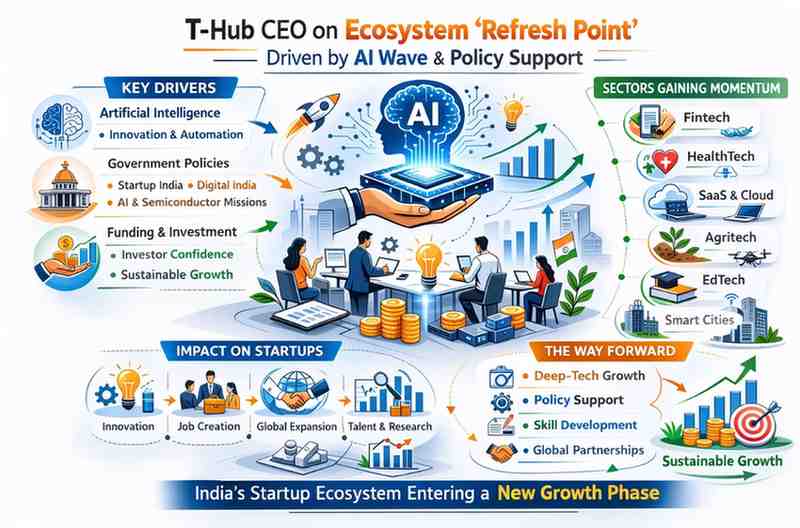
India’s startup ecosystem is entering what the CEO of T-Hub calls a “refresh point,” driven largely by the artificial intelligence (AI) wave and supportive government policies.
Speaking about the evolving innovation landscape, the T-Hub leadership highlighted how global AI momentum and India’s digital policy environment are creating new growth pathways for startups, especially in deep tech and enterprise solutions.


The development matters now because India’s startup sector is emerging from a funding slowdown phase. With fresh interest in AI-led innovation and stronger policy backing, many ecosystem leaders believe the next growth cycle has begun.
What Is T-Hub and Why It Matters
T-Hub, based in Hyderabad, is one of India’s largest startup incubators. It was launched by the Government of Telangana in partnership with leading academic institutions and industry stakeholders.
The organisation supports early-stage startups through:
- Mentorship programmes
- Corporate partnerships
- Investor connections
- International market access
- Innovation labs
Since its launch in 2015, T-Hub has worked with thousands of startups across sectors including fintech, healthtech, agritech, and SaaS.
The CEO’s remarks reflect broader changes across India’s startup ecosystem.
AI Wave Reshaping Startup Focus
Artificial intelligence has become the central theme in global technology discussions.
The rapid rise of generative AI tools and enterprise AI platforms has changed investor priorities. Startups are now integrating AI into products across sectors such as:
- Healthcare diagnostics
- Financial risk analysis
- Agriculture forecasting
- Logistics optimisation
- Customer support automation
According to T-Hub leadership, many founders are pivoting toward AI-driven solutions.
The AI wave is not limited to new startups. Existing companies are also embedding AI into their offerings to remain competitive.
Policy Support Strengthening Innovation
Government policies are playing a major role in this ecosystem shift.
India has introduced several technology-focused initiatives in recent years, including:
- Startup India
- Digital India
- Semiconductor incentives
- AI research missions
These policies aim to improve infrastructure, ease regulations, and support innovation funding.
The T-Hub CEO noted that policy clarity and digital governance improvements are encouraging founders to think long term.
Simplified compliance and stronger digital public infrastructure, such as UPI and Aadhaar-based services, have helped startups scale faster.
From Funding Winter to Reset Phase
India’s startup funding landscape saw a slowdown in 2022 and 2023, following a global venture capital correction.
Valuations adjusted downward. Investors became cautious. Startups focused more on profitability than expansion.
However, ecosystem leaders now describe the current phase as a “refresh” rather than a downturn.
This reset has pushed founders to:
- Build stronger business models
- Focus on revenue sustainability
- Reduce burn rates
- Develop product-market fit
AI-led startups are attracting renewed investor attention, particularly in enterprise SaaS and automation.
Hyderabad’s Growing Role in AI Innovation
Hyderabad has steadily strengthened its position as a technology hub.
With the presence of global technology firms and research centres, the city has access to skilled engineers and data scientists.
T-Hub’s infrastructure provides:
- Co-working spaces
- Corporate innovation partnerships
- Global accelerator programmes
The AI wave is further enhancing Hyderabad’s startup visibility.
Many founders are now building AI tools tailored to Indian markets, including language processing solutions for regional languages.
Enterprise AI Driving Revenue Models
Unlike earlier tech cycles that focused heavily on consumer apps, the current AI phase is enterprise-focused.
Companies are developing:
- AI-powered analytics dashboards
- Automated workflow systems
- AI-based fraud detection
- Supply chain forecasting tools
Enterprise clients offer stable revenue streams.
This shift toward B2B (business-to-business) AI solutions is seen as more sustainable compared to purely consumer-based growth models.
Global Collaboration and Market Access
The T-Hub CEO also highlighted the importance of international partnerships.
Indian startups are increasingly targeting:
- Middle East markets
- Southeast Asia
- North America
- Europe
AI products built in India are being tested in global markets.
International collaborations provide exposure to advanced use cases and larger customer bases.
Skill Development and Talent Demand
The AI wave has increased demand for skilled professionals in areas such as:
- Machine learning
- Data engineering
- Cloud computing
- Cybersecurity
Indian universities and private institutes are expanding AI training programmes.
T-Hub and other incubators are working with academic institutions to bridge skill gaps.
The CEO emphasised that talent depth remains India’s biggest advantage.
Challenges Still Remain
Despite the positive outlook, challenges remain.
Startups must navigate:
- Global competition
- Data privacy regulations
- Infrastructure scaling costs
- Responsible AI practices
AI systems must also comply with ethical standards.
Responsible AI development is becoming a global priority.
India is also working on regulatory frameworks to ensure safe and fair AI deployment.
Investor Sentiment Improving
While overall funding has not returned to peak levels seen in 2021, investor sentiment appears to be stabilising.
Early-stage AI startups are drawing interest from:
- Domestic venture funds
- Corporate venture arms
- Angel investors
Investors are now looking for clear revenue models rather than rapid user growth alone.
This marks a more mature phase in India’s startup journey.
What the ‘Refresh Point’ Means for Founders
According to ecosystem leaders, the “refresh point” signals:
- More disciplined growth
- Stronger technology focus
- Long-term sustainability
- Policy-backed innovation
For founders, this means building durable businesses rather than chasing short-term valuations.
The AI wave offers new opportunities, but success will depend on execution quality.
Why This Matters for India’s Digital Economy
India’s ambition to become a global digital powerhouse depends heavily on startup innovation.
The combination of:
- AI-driven technology
- Policy support
- Skilled workforce
- Digital public infrastructure
creates a strong foundation for the next growth cycle.
T-Hub’s perspective reflects a broader national shift toward deep-tech leadership.
Conclusion
The CEO of T-Hub has described the current moment as a “refresh point” for India’s startup ecosystem, powered by the AI wave and supportive policy frameworks.
After a period of funding caution, startups are now entering a more focused and sustainable phase.
With enterprise AI solutions gaining traction and Hyderabad strengthening its role as an innovation hub, the coming years could define India’s position in the global AI economy.
For founders, investors, and policymakers, the message is clear: the ecosystem is not slowing it is evolving.
And the next phase may be driven not by hype, but by smarter innovation and long-term value creation.
Disclaimer: The information presented in this article is intended for general informational purposes only. While every effort is made to ensure accuracy, completeness, and timeliness, data such as prices, market figures, government notifications, weather updates, holiday announcements, and public advisories are subject to change and may vary based on location and official revisions. Readers are strongly encouraged to verify details from relevant official sources before making financial, investment, career, travel, or personal decisions. This publication does not provide financial, investment, legal, or professional advice and shall not be held liable for any losses, damages, or actions taken in reliance on the information provided.
Last Updated on Friday, February 20, 2026 12:17 pm by Startup Newswire Team